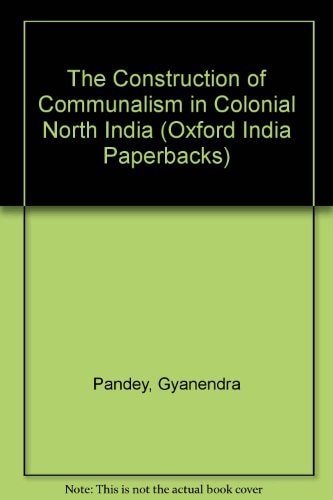
Construction of Communalism in Colonial India
0
0
As an Amazon Associate and affiliate partner, Menrva Books earns from qualifying purchases. Learn more
Author Description
In colonialist writing, "communalism" is a concept that stands for the puerile and the primitive--for all that colonialism itself, in its own reckoning, was not. It is therefore paradoxical that the use of this concept has been propagated, more than anyone else, by nationalists and opponents of colonialism. In this radically new analysis of the problem of communalism in India, the author therefore has as much to say about nationalism as about colonialism. He argues that both these concepts are products of the Age of Colonialism, of Reason, and of Capital. His investigation of communalism is part of a larger exercise aimed at understanding the construction of Indian society and politics as a whole in recent times.
Menrva's Summary
THE THESIS
This book investigates the historical and political construction of the concept of 'communalism' within the context of colonial India. Gyanendra Pandey, a prominent historian of modern India, challenges the conventional understanding of communalism as a primitive relic. He argues that both nationalism and communalism are modern constructs emerging from the Age of Colonialism, Reason, and Capital, and that understanding these concepts is essential to grasping the formation of contemporary Indian society and politics.
THE SCOPE MAP
What You Will Find
- A critical analysis of colonialist historiography and its definition of communalism.
- An examination of the intersection between nationalist discourse and colonial administrative categories.
- A theoretical framework linking the rise of communalism to the broader development of modern capital and rationalist thought.
- Case studies illustrating the socio-political shifts in India during the colonial era.
THE AUTHORITY PERSPECTIVE
Scholars and historians frequently cite this work as a foundational text for understanding the discursive construction of identity in South Asia. Readers often note the academic density of the prose, which requires a strong background in postcolonial theory and Indian history to fully appreciate the author's nuanced arguments.
Page Count:
300
Publication Date:
1998-06-01
Publisher:
Oxford University Press
ISBN-10:
0195630106
ISBN-13:
9780195630107
History
India
Sociology
Community Tags
Similar Books