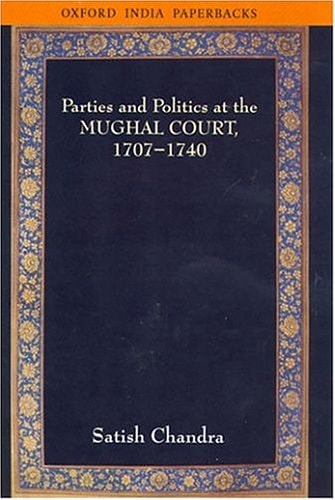
Parties and Politics at the Mughal Court, 1707-1740
0
0
As an Amazon Associate and affiliate partner, Menrva Books earns from qualifying purchases. Learn more
Author Description
This important book provides a new perspective on the decline of the Mughal empire, departing from the existing appraisement of Aurangzeb, the functioning of the Mughal nobility and the crisis of the jagirdari system. It re-examines the first half of the eighteenth century, which was a period of growing anarchy and cultural stagnation. The post-Aurangzeb period has been presented as one in which struggle for liberal and orthodox policies was linked with the struggles to make the wazir a key player. The author studies the role of the nobility in the downfall of the Mughal empire- a subject of unresolved conflict- with special reference to the position of various ethnic and religious groups in the nobility after the death of Aurangzeb, the basis of the rise and struggle of parties at the court and its impact, the rise of the Marathas, Jats and other indigenous elements, and developments in the field of administration. In a new preface to this edition, he contends that the core of the crisis of the Mughal empire is linked to the collapse of the jagirdari system with a deepening social crisis and increased factionalism in the ruling classes leading to a breakup of a central polity. In this classic work, Professor Chandra revisits the political history of this period by using for the first time valuable records, letters and a number of monographs hitherto unavailable to other researchers. First published in 1959, the present edition will continue to be an invaluable resource for historians and students of medieval and late-medieval India.
Menrva's Summary
THE THESIS
This work investigates the underlying causes of the Mughal Empire's decline between 1707 and 1740 by analyzing the intersection of factional politics and administrative instability. Satish Chandra, a distinguished historian of medieval India, utilizes previously untapped primary source materials, including letters and administrative records, to challenge traditional interpretations of the post-Aurangzeb era. He argues that the collapse was not merely a result of individual leadership failures but was fundamentally rooted in the disintegration of the jagirdari system and the resulting intensification of social and political factionalism among the nobility.
THE SCOPE MAP
What You Will Find
- Analysis of the political and social dynamics within the Mughal nobility following the death of Aurangzeb.
- Examination of the jagirdari system and its role in the broader economic and administrative crisis of the empire.
- Investigation into the rise of regional powers such as the Marathas and Jats and their impact on central authority.
- Use of primary source documents, including contemporary letters and monographs, to reconstruct the political landscape of the early eighteenth century.
THE AUTHORITY PERSPECTIVE
Historians and scholars of South Asian studies widely recognize this text as a foundational analysis of the late Mughal period. Readers frequently note the academic density of the prose and the rigorous archival methodology employed by the author to explain the complexities of imperial decline.
Page Count:
384
Publication Date:
2004-01-01
Publisher:
OUP India
ISBN-10:
0195667905
ISBN-13:
9780195667905
Politics
History
Asian History
Mogul Empire
India
Political History
Mughal Empire
Community Tags
Similar Books