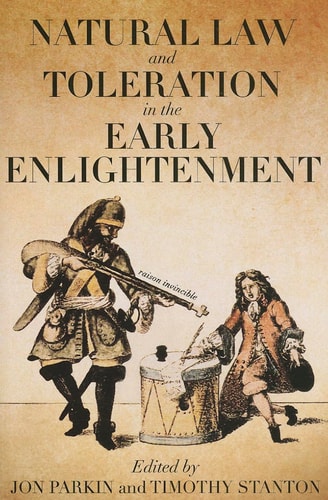
Natural Law and Toleration in the Early Enlightenment
0
0
As an Amazon Associate and affiliate partner, Menrva Books earns from qualifying purchases. Learn more
Author Description
The early enlightenment has been seen as an epoch-making period in the development of modern Europe, marking the beginnings of the transition from a 'religious' to an essentially 'secular' understanding of human relations and generating in the process new accounts of the relationship between religion and politics, in which the idea of toleration figured centrally. In this volume of essays, leading scholars in the field challenge that view and explore the ways in which some of the most important discussions of toleration in the western tradition were shaped by understandings of natural theology and natural law. Far from representing a shift to non-religious ways of thinking about the world, the essays reveal the extent to which early enlightenment discussions of toleration presupposed a world-view in which God-given natural law established the boundaries between church and state and provided the primary point of reference for understanding claims to religious freedom.The book offers significant new interpretations of the relationship between natural theology and toleration in the works of Samuel Pufendorf, John Locke, G. W. Leibniz, Christian Thomasius, Jean Barbeyrac, and Francis Hutcheson. These interpretations suggest sometimes extensive revisions to contemporary thinking about these works and to the assumptions about the early enlightenment and its role in shaping liberal modernity it embodies. By carefully examining the arguments of these writers in their original contexts, without the interference of modern categories, and by setting those arguments in sequence, this book reveals an important transformation in modern thought, one that is yet continuous with the past and which poses some pointed questions for both the present and the future.
Menrva's Summary
THE THESIS
This volume investigates the extent to which early Enlightenment discussions of religious toleration were fundamentally rooted in natural theology and natural law rather than secularism. Editors John Parkin and Timothy Stanton curate a collection of essays from leading scholars who challenge the traditional narrative of a clean transition from religious to secular governance. By analyzing the works of key figures such as John Locke and Samuel Pufendorf within their original historical contexts, the contributors argue that God-given natural law served as the primary framework for defining the boundaries between church and state.
THE SCOPE MAP
What You Will Find
- Historical analysis of the relationship between natural theology and political toleration in the 17th and 18th centuries.
- Re-evaluations of primary texts by Samuel Pufendorf, John Locke, G. W. Leibniz, Christian Thomasius, Jean Barbeyrac, and Francis Hutcheson.
- Methodological focus on interpreting philosophical arguments within their original intellectual and religious contexts.
- Critical examination of the transition from religious to secular understandings of human relations in modern Europe.
THE AUTHORITY PERSPECTIVE
Scholars and historians of political thought identify this collection as a significant intervention in Enlightenment studies that complicates the standard secularization thesis. Readers frequently note the academic density of the prose and the rigorous, context-heavy approach employed by the contributors to reframe foundational liberal concepts.
Page Count:
300
Publication Date:
2013-06-15
Publisher:
British Academy
ISBN-10:
0197265405
ISBN-13:
9780197265406
History
Religion
Philosophy
Natural theology
Natural law
Enlightenment
Law europe
Toleration
Community Tags
Similar Books