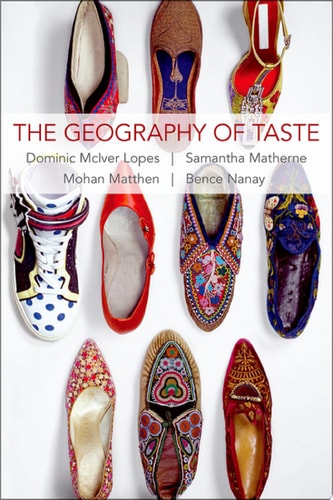
The Geography of Taste (Thinking Art)
0
0
As an Amazon Associate and affiliate partner, Menrva Books earns from qualifying purchases. Learn more
Author Description
This is an open access title available under the terms of a CC BY-NC-ND 4.0 license. It is free to read at Oxford Academic and offered as a free PDF download from OUP and selected open access locations.Wherever on the globe anyone sets foot, they find people immersed in matters aesthetic. In UNESCO's definition, there can be no culture that lacks an aesthetic life. Aesthetic life is in this sense a cultural universal. At the same time, aesthetic engagement has a geography. While all cultures have an aesthetic, no single aesthetic belongs to all cultures. The rules of aesthetic engagement vary by culture.How should aesthetics proceed if we take this fact of aesthetic diversity, rather than the presumption of aesthetic universality as our starting point? How should we theorize the cultural origins and cultural basis of aesthetic diversity? How should we think about the value and normativity of aesthetic diversity? To model what the turn toward diversity might look like in aesthetic inquiry, the four authors of this book each defend a different account of aesthetic diversity, and together they engage in a collective dialogue about these issues. The Geography of Taste will interest students in aesthetics courses as well as others interested in novel, global approaches to aesthetics.
Menrva's Summary
THE THESIS
This book investigates how aesthetic inquiry must be reconfigured when aesthetic diversity, rather than universality, is established as the primary starting point for cultural analysis. The authors, a group of distinguished scholars in philosophy and aesthetics, utilize cross-cultural data and philosophical argumentation to challenge traditional Western-centric models of taste. They propose a framework that accounts for the origins, normativity, and value of aesthetic variation across global cultures, moving away from the assumption that aesthetic rules are uniform.
THE SCOPE MAP
What You Will Find
- Comparative analysis of aesthetic engagement across diverse global cultures.
- Theoretical models for understanding the cultural origins of aesthetic diversity.
- Philosophical arguments regarding the normativity and value of varying aesthetic standards.
- A collaborative dialogue format featuring four distinct scholarly perspectives on aesthetic inquiry.
THE AUTHORITY PERSPECTIVE
Experts identify this work as a significant contribution to the field of global aesthetics, noting its departure from traditional universalist paradigms. Readers frequently highlight the academic rigor of the text and its utility for students and researchers seeking to integrate cultural diversity into philosophical discourse.
Page Count:
216
Publication Date:
2024-01-01
Publisher:
Oxford University Press
ISBN-10:
0197509061
ISBN-13:
9780197509067
Philosophy
Sociology
Aesthetics
Art Theory
Community Tags
Similar Books