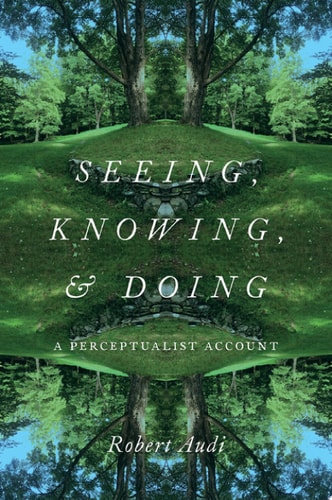
Seeing, Knowing, and Doing: A Perceptualist Account
0
0
As an Amazon Associate and affiliate partner, Menrva Books earns from qualifying purchases. Learn more
Author Description
Perception is basic for human knowledge and a major concern of both epistemology and the philosophy of mind. The scholarship in this area, however, has left two important aspects of perception underexplored: its relevance to understanding a priori knowledge-traditionally conceived as independent of perception-and its role in human action. This book provides a full-scale account of perception, a theory of the a priori, and an account of how perception guides action. In exploring perception and action, it clarifies the relation between action and practical reasoning, the notion of rational action, and the relation between knowledge of the practical (of how things are done) and practical knowledge (knowing how to do things). In the first part of the book, Robert Audi lays out a theory of perception as experiential, representational, and causally connected with its objects. He argues that perception is a discriminative response to its objects; it embodies phenomenally distinctive elements; and it yields rich information that underlies human knowledge. Part Two presents a theory of self-evidence and the a priori. Audi's theory is perceptualist in that it explicates the apprehension of a priori truths by articulating its parallels to perception. The theory also unifies empirical and a priori knowledge by clarifying their reliable causal connections with their objects-connections many have thought impossible for a priori knowledge. The final part explores how perception guides action, the role of propositional knowledge in our abilities to do what we know how to do, the nature of reasons for action, the role of inference in determining it, and the overall conditions for its rationality. Addressing longstanding questions left unaddressed in the current literature, Audi's comprehensive theory of perception will appeal to scholars and students interested in philosophy of perception, mind, and epistemology.
Menrva's Summary
THE THESIS
How does perception function as a foundational element in human knowledge, the apprehension of a priori truths, and the guidance of rational action? Robert Audi, a prominent philosopher, utilizes his extensive background in epistemology and ethics to construct a unified theory of perceptualism. He argues that perception is not merely a passive intake of data but an active, representational, and causal process that bridges the gap between empirical observation and abstract reasoning.
THE SCOPE MAP
What You Will Find
- A comprehensive theory of perception as an experiential and discriminative response to external objects.
- An analysis of self-evidence and the nature of a priori knowledge through a perceptualist lens.
- An investigation into the causal connections between propositional knowledge and practical action.
- A framework for understanding rational action and the role of inference in human behavior.
THE AUTHORITY PERSPECTIVE
Scholars and students of philosophy frequently identify this work as a significant contribution to the intersection of epistemology and the philosophy of mind. Experts highlight the text's academic density and its systematic approach to reconciling empirical and a priori knowledge.
Page Count:
242
Publication Date:
2020-01-01
Publisher:
Oxford University Press
ISBN-10:
0197503527
ISBN-13:
9780197503522
Philosophy
Politics
Knowledge Theory
Epistemology
Metaphysics
Mind & Body
Community Tags
Similar Books