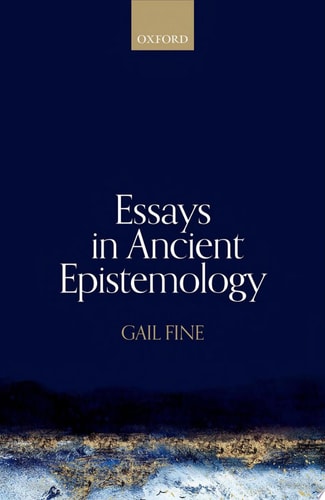
Essays in Ancient Epistemology
0
0
As an Amazon Associate and affiliate partner, Menrva Books earns from qualifying purchases. Learn more
Author Description
Focusing primarily on Plato, Aristotle, and the Pyrrhonian skeptics, Fine discusses the following questions, among others: does Socrates, in the Apology, claim to know that he knows nothing? How do Plato and Aristotle conceive of doxa and epistêmê? Are doxa and epistêmê belief and knowledge as we conceive of them nowadays? Do Plato and Aristotle allow us to have doxa of everything about which we can have epistêmê? How does Plato conceive of perception in the Phaedo and in Theaetetus 184-6? How should we understand his theory of recollection in the Phaedo? Do the Pyrrhonian skeptics disavow all beliefs? Do they have a conception of purely subjective experience? Do they take anything to be subjective? Are they external world skeptics? How do their views of subjectivity and skepticism compare with Descartes'? Taken as a whole, the essays explain why ancient epistemology is instructive and illuminating for us today.
Menrva's Summary
THE THESIS
This collection investigates the foundational concepts of knowledge and belief as articulated by Plato, Aristotle, and the Pyrrhonian skeptics. Gail Fine, a prominent scholar of ancient philosophy, utilizes rigorous textual analysis to examine how these thinkers defined epistêmê and doxa. By situating these ancient arguments within their historical context, the author evaluates their relevance to modern epistemological debates and contemporary philosophical inquiry.
THE SCOPE MAP
What You Will Find
- Comparative analysis of Platonic and Aristotelian definitions of knowledge and belief
- Examination of Socratic irony regarding the claim of knowing nothing
- Investigation into Pyrrhonian skepticism and its stance on belief and subjectivity
- Critical assessment of perception theories in the Phaedo and Theaetetus
- Comparative study between ancient skepticism and Cartesian philosophy
Scope Limits
- The text does not provide a comprehensive history of all ancient epistemological schools
- It does not attempt to resolve modern epistemological problems, but rather uses ancient thought to illuminate them
THE AUTHORITY PERSPECTIVE
Scholars and students of philosophy frequently cite this collection as a rigorous and essential resource for understanding the nuances of ancient Greek epistemology. Readers often note the academic density of the prose, which requires a strong background in classical texts to fully appreciate the author's arguments.
Page Count:
416
Publication Date:
2021-01-01
Publisher:
OUP Oxford
ISBN-10:
0191063703
ISBN-13:
9780191063701
Philosophy
Knowledge Theory
History & Surveys
Philosophy history
Epistemology
Community Tags
Similar Books