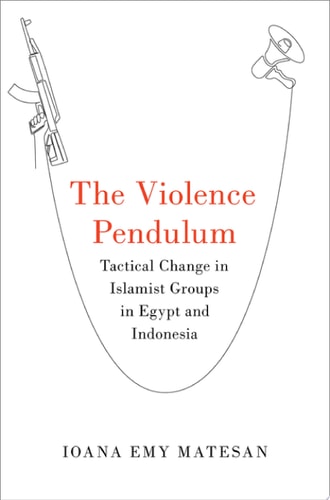
The Violence Pendulum: Tactical Change in Islamist Groups in Egypt and Indonesia
0
0
As an Amazon Associate and affiliate partner, Menrva Books earns from qualifying purchases. Learn more
Author Description
Would the Islamic State ever renounce violence? In the current political climate, the question seems preposterous. Yet, at the height of a terrorist campaign against tourists in Egypt during the 1990s, nobody expected that the group behind the attacks would issue and adhere to a nonviolence initiative. What drives groups to shift between nonviolence and violence? When do opposition groups move away from armed action, and why do some organizations renounce violence permanently, whereas others refrain temporarily? In The Violence Pendulum, Ioana Emy Matesan offers a theory of tactical change that explains both escalation and de-escalation in order to answer these questions.Matesan's analysis traces the historical evolution of four Islamist groups: the Muslim Brotherhood and al-Gama'a al-Islamiyya in Egypt, and Darul Islam and Jemaah Islamiyah in Indonesia. Drawing from archival materials, interviews, and reports, she focuses on turning points in each organization. Ultimately, she finds that Islamist groups alter their tactics in response to the perceived need for activism, shifts in the cost of violent versus nonviolent resistance, and internal or external pressures on the organization. Groups turn to violence when grievances escalate, violent resistance is feasible and publicly tolerated, and there are internal or external pressures to act. In turn, groups renounce armed action when violence costs them too much, disillusionment eclipses the perceived need for continued activism, and leaders are willing to rethink the tactics and strategies of the group. By uncovering the reasons for escalation and de-escalation across a range of political environments, The Violence Pendulum reshapes our understanding of how decisions are made--and how nonviolence can be achieved--in armed groups.
Menrva's Summary
THE THESIS
This book investigates the underlying mechanisms that drive Islamist organizations to oscillate between violent insurgency and nonviolent political activism. Ioana Emy Matesan, a scholar of political violence and conflict, utilizes a comparative framework to analyze the strategic decision-making processes within militant groups. By examining the interplay between organizational survival, perceived political efficacy, and shifting cost-benefit analyses, she presents a theory of tactical change that accounts for both escalation and de-escalation in diverse political environments.
THE SCOPE MAP
What You Will Find
- Comparative historical analysis of four specific Islamist groups: the Muslim Brotherhood, al-Gama'a al-Islamiyya, Darul Islam, and Jemaah Islamiyah.
- A theoretical framework for understanding tactical shifts based on internal organizational pressures and external political constraints.
- Empirical evidence derived from extensive archival research, primary source reports, and expert interviews.
- An examination of the conditions under which armed groups choose to renounce violence permanently versus those that engage in temporary tactical pauses.
THE AUTHORITY PERSPECTIVE
Experts in the field of security studies and political science recognize this work as a rigorous contribution to the study of militant organizational behavior. Readers frequently note the academic density of the prose and the systematic nature of the comparative methodology employed by the author.
Page Count:
288
Publication Date:
2020-01-01
Publisher:
Oxford University Press
ISBN-10:
0197510108
ISBN-13:
9780197510100
History
Comparative Politics
Asian Studies
Violence
International relations
Community Tags
Similar Books