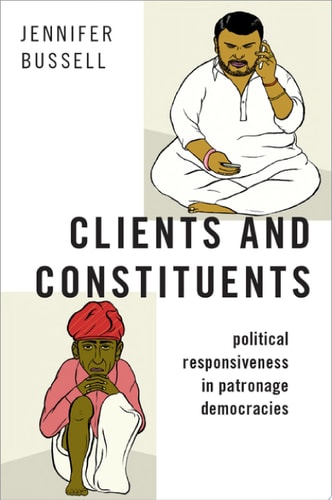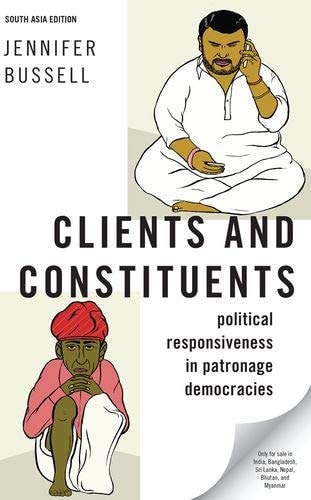
Clients and Constituents: Political Responsiveness in Patronage Democracies
0
0
As an Amazon Associate and affiliate partner, Menrva Books earns from qualifying purchases. Learn more
Author Description
"Existing work suggests that legislators in countries like India should spend little time engaging with individual citizens and, if they do, should focus their attention on co-partisans. Yet, there is anecdotal evidence that these politicians actually spend substantial time assisting individual citizens with access to basic state services. In this book, I show that helping individual voters is a key part of these representatives' activities and that, in contrast with existing expectations, they do not generally discriminate against their non-copartisans in providing assistance. Yet, this constituency service differs from that observed in Western democracies, as it arises from the partisan nature of distribution at the local level. Thus, Indian politicians are more accountable to citizens than we previously expected, but this accountability is linked to, and constrained by, the character of patronage-based politics"--
Menrva's Summary
THE THESIS
This book investigates the paradox of political responsiveness in India, questioning why legislators dedicate significant time to individual citizen assistance despite theoretical expectations of partisan exclusion. Jennifer Bussell, a scholar of comparative politics, utilizes original survey data and field research to analyze the mechanics of constituency service. She argues that while Indian politicians are indeed responsive to individual needs, this behavior is fundamentally shaped by the local patronage networks that define the democratic landscape.
THE SCOPE MAP
What You Will Find
- Analysis of legislator behavior in patronage-based democratic systems
- Comparative framework contrasting Indian political service with Western models
- Empirical data regarding the distribution of state services to co-partisans versus non-co-partisans
Scope Limits
- The study focuses primarily on the Indian political context and may not be fully generalizable to all developing democracies
- The analysis does not cover national-level policy-making or legislative voting records in detail
THE AUTHORITY PERSPECTIVE
Experts recognize this work as a significant contribution to the study of political accountability in non-Western contexts. Readers frequently note the clarity of the author's argument and the rigor of the empirical evidence provided.
Page Count:
0
Publication Date:
1900-01-01
Publisher:
Oxford
ISBN-10:
0190082100
ISBN-13:
9780190082109
Asian Studies
Comparative Politics
Public Policy
Democracy