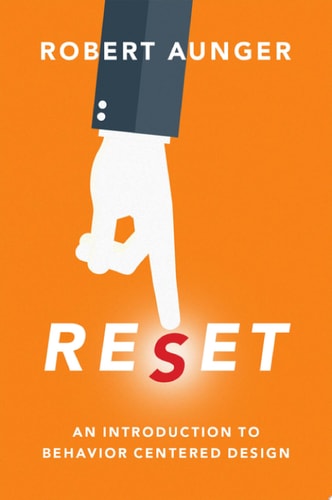
Reset: An Introduction to Behavior Centered Design
0
0
As an Amazon Associate and affiliate partner, Menrva Books earns from qualifying purchases. Learn more
Author Description
Many of us would like to change one or more of our own behaviors, or those of others. Governments and public health officials frequently initiate programs to promote behavior change on a broad scale. But behavior change is difficult, and success frequently eludes us.Reset: An Introduction to Behavior Centered Design presents a new framework for achieving behavior change that draws on recent advances in neuroscience, evolutionary biology, and ecological psychology. Behavior Centered Design provides a behavioral model derived from reinforcement learning theory, develops a fundamental taxonomy of needs based in evolutionary biology, shows how the disruption of behavior settings is key, and lays out the steps involved in programming for behavior change. Part 1 of Reset begins with an in-depth presentation of the theory behind the model - such as how BCD conceptualizes behavior change - and emphasizes the key principles of surprise, revaluation, and performance. Part 2 is a step-by-step manual for conceiving, creating, implementing, and evaluating a behavior change program. Numerous real-life examples are provided, as well as additional resources to support mastery of the BCD approach. Applied successfully to a range of public health behaviors as well as in commercial product design and marketing, the BCD approach encourages behavior change practitioners to think differently about behavior - both in understanding how and why it is produced, and in how to design programs to change it.
Menrva's Summary
THE THESIS
This book investigates the core question of how to effectively engineer behavior change by integrating insights from evolutionary biology, neuroscience, and ecological psychology. Robert Aunger, a researcher in the field of behavioral science, presents the Behavior Centered Design (BCD) framework as a structured alternative to traditional change models. The text argues that successful modification of habits requires a deep understanding of reinforcement learning and the strategic disruption of established behavioral settings. By moving beyond simple motivation-based approaches, the author provides a rigorous methodology for practitioners in public health and commercial design.
THE SCOPE MAP
What You Will Find
- A comprehensive taxonomy of human needs rooted in evolutionary biology.
- A step-by-step manual for conceiving, implementing, and evaluating behavior change programs.
- Theoretical foundations including reinforcement learning theory and the principles of surprise, revaluation, and performance.
- Practical case studies demonstrating the application of BCD in public health and product design.
THE AUTHORITY PERSPECTIVE
Experts and practitioners in the field of behavioral design view this work as a foundational text for those seeking a scientific, evidence-based approach to intervention. Readers frequently note the academic density of the prose, which balances high-level theoretical concepts with actionable, manual-style instructions for program development.
Page Count:
171
Publication Date:
2020-01-01
Publisher:
Oxford University Press
ISBN-10:
0197532659
ISBN-13:
9780197532652
Psychology
Public Health
Behavioral Science
Self Help
Design
Medical
Allied Health
Community Tags
Similar Books