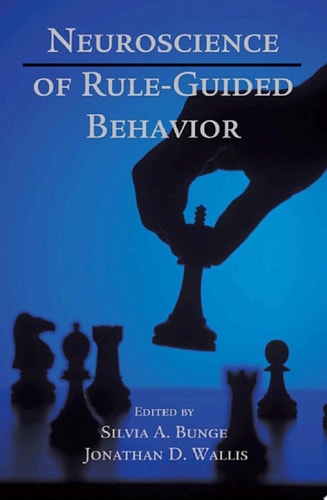
Neuroscience of Rule-Guided Behavior
0
0
As an Amazon Associate and affiliate partner, Menrva Books earns from qualifying purchases. Learn more
Author Description
Neuroscience of Rule-Guided Behavior brings together, for the first time, the experiments and theories that have created the new science of rules. Rules are central to human behavior, but until now the field of neuroscience lacked a synthetic approach to understanding them. How are rules learned, retrieved from memory, maintained in consciousness and implemented? How are they used to solve problems and select among actions and activities? How are the various levels of rules represented in the brain, ranging from simple conditional ones if a traffic light turns red, then stop to rules and strategies of such sophistication that they defy description? And how do brain regions interact to produce rule-guided behavior? These are among the most fundamental questions facing neuroscience, but until recently there was relatively little progress in answering them. It was difficult to probe brain mechanisms in humans, and expert opinion held that animals lacked the capacity for such high-level behavior. However, rapid progress in neuroimaging technology has allowed investigators to explore brain mechanisms in humans, while increasingly sophisticated behavioral methods have revealed that animals can and do use high-level rules to control their behavior. The resulting explosion of information has led to a new science of rules, but it has also produced a plethora of overlapping ideas and terminology and a field sorely in need of synthesis. In this book, Silvia Bunge and Jonathan Wallis bring together the worlds leading cognitive and systems neuroscientists to explain the most recent research on rule-guided behavior. Their work covers a wide range of disciplines and methods, including neuropsychology, functional magnetic resonance imaging, neurophysiology, electroencephalography, neuropharmacology, near-infrared spectroscopy, and transcranial magnetic stimulation. This unprecedented synthesis is a must-read for anyone interested in how complex behavior is controlled and organized
Menrva's Summary
THE THESIS
This volume investigates the neural mechanisms and cognitive processes that enable the human brain to learn, maintain, and implement rule-guided behavior. Editors Jonathan D. Wallis and Silvia A. Bunge synthesize disparate research findings to establish a cohesive framework for understanding how the brain translates abstract rules into concrete actions. By integrating perspectives from cognitive and systems neuroscience, the text addresses how rule complexity is represented across various neural architectures.
THE SCOPE MAP
What You Will Find
- Analysis of rule acquisition, retrieval, and maintenance in consciousness
- Examination of neural interactions during problem-solving and action selection
- Review of methodologies including fMRI, EEG, neuropharmacology, and TMS
- Comparative studies between human and animal behavioral capacities
Scope Limits
- Does not provide a comprehensive clinical manual for treating behavioral disorders
- Excludes philosophical or sociological debates regarding the nature of free will
THE AUTHORITY PERSPECTIVE
Experts recognize this work as a foundational synthesis for researchers attempting to navigate the complex terminology and overlapping theories within the field. Readers frequently note the academic density of the prose, which is tailored specifically for advanced students and professional neuroscientists.
Page Count:
499
Publication Date:
2007-01-01
Publisher:
Oxford University Press
ISBN-10:
0190295422
ISBN-13:
9780190295424
Psychology
Biology
Behavioral Science
Medical
Neuroscience
Allied Health
Community Tags
Other Editions(4)



Similar Books







Reader Comments
Share Your Thoughts
No comments yet. Be the first to share your thoughts!