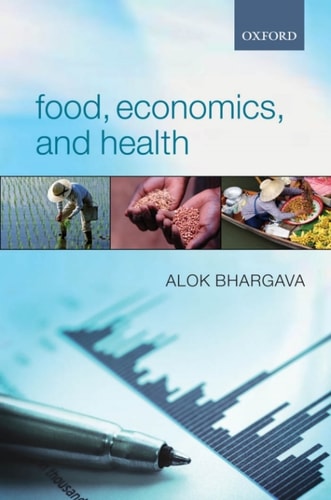
Food, Economics, and Health
0
0
As an Amazon Associate and affiliate partner, Menrva Books earns from qualifying purchases. Learn more
Author Description
Drawing on the author's extensive and varied research, this book provides readers with a firm grounding in the concepts and issues across several disciplines including economics, nutrition, psychology and public health in the hope of improving the design of food policies in the developed and developing world. Using longitudinal (panel) data from India, Bangladesh, Kenya, the Philippines, Vietnam, and Pakistan and extending the analytical framework used in economics and biomedical sciences to include multi-disciplinary analyses, Alok Bhargava shows how rigorous and thoughtful econometric and statistical analysis can improve our understanding of the relationships between a number of socioeconomic, nutritional, and behavioural variables on a number of issues like cognitive development in children and labour productivity in the developing world. These unique insights combined with a multi-disciplinary approach forge the way for a more refined and effective approach to food policy formation going forward. A chapter on the growing obesity epidemic is also included, highlighting the new set of problems facing not only developed but developing countries. The book also includes a glossary of technical terms to assist readers coming from a variety of disciplines.
Menrva's Summary
THE THESIS
This book investigates how interdisciplinary econometric and statistical analysis can refine food policy design to address global nutritional and socioeconomic challenges. Alok Bhargava, an expert in health economics and nutrition, utilizes longitudinal data from diverse developing nations to bridge the gap between biomedical science and economic theory. He argues that by integrating behavioral and nutritional variables into policy frameworks, governments can more effectively address issues ranging from childhood cognitive development to labor productivity.
THE SCOPE MAP
What You Will Find
- Longitudinal panel data analysis from India, Bangladesh, Kenya, the Philippines, Vietnam, and Pakistan.
- Econometric models linking socioeconomic status, nutrition, and behavioral variables.
- A dedicated examination of the global obesity epidemic and its impact on both developed and developing economies.
- A comprehensive glossary of technical terms for interdisciplinary accessibility.
Scope Limits
- The text focuses primarily on the application of econometric modeling rather than providing a broad historical overview of global food systems.
- It does not offer specific policy prescriptions for every individual country, focusing instead on the analytical framework for policy formation.
THE AUTHORITY PERSPECTIVE
Experts recognize this work as a rigorous synthesis of health economics and nutritional science, noting its utility for researchers and policymakers alike. Readers frequently highlight the technical density of the statistical analysis, which serves as a foundational resource for those seeking to apply quantitative methods to public health policy.
Page Count:
240
Publication Date:
2008-01-01
Publisher:
Oxford University Press
ISBN-10:
019155636X
ISBN-13:
9780191556364
Economics
Medical
Allied Health
Food supply
Food Policy
Nutrition
Public Health
Behavioral Science
Community Tags
Similar Books