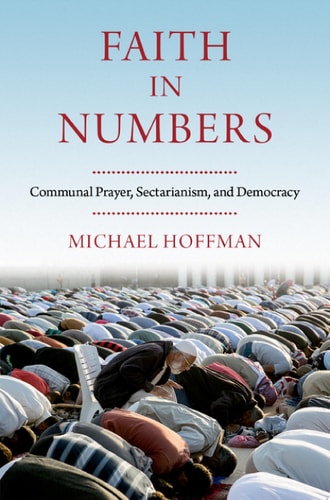
Faith in Numbers: Religion, Sectarianism, and Democracy
0
0
As an Amazon Associate and affiliate partner, Menrva Books earns from qualifying purchases. Learn more
Author Description
Why does religion sometimes increase support for democracy and sometimes do just the opposite? In Faith in Numbers, political scientist Michael Hoffman presents a theory of religion, group interest, and democracy. Focusing on communal religion, he demonstrates that the effect of communal prayer on support for democracy depends on the interests of the religious group in question. For members of groups who would benefit from democracy, communal prayer increases support for democratic institutions; for citizens whose groups would lose privileges in the event of democratic reforms, the opposite effect is present. Using a variety of data sources, Hoffman illustrates these claims in multiple contexts. He places particular emphasis on his study of Lebanon and Iraq, two countries in which sectarian divisions have played a major role in political development, by utilizing both existing and original surveys. By examining religious and political preferences among both Muslims and non-Muslims in several religiously diverse settings, Faith in Numbers shows that theological explanations of religion and democracy are inadequate. Rather, it demonstrates that religious identities and sectarian interests play a major part in determining regime preferences and illustrates how Islam in particular can be mobilized for both pro- and anti-democratic purposes. It finds that Muslim religious practice is not necessarily anti-democratic; in fact, in a number of settings, practicing Muslims are considerably more supportive of democracy than their secular counterparts. Theological differences alone do not determine whether members of religious groups tend to support or oppose democracy; rather, their participation in communal worship motivates them to view democracy through a sectarian lens.
Menrva's Summary
THE THESIS
This book investigates the conditions under which religious practice either bolsters or undermines support for democratic governance. Michael Hoffman, a political scientist, challenges the notion that theological doctrine is the primary driver of political preference. Instead, he argues that communal religious participation functions as a mechanism for group interest, where the perceived benefits or losses of democratic reform dictate the political orientation of the faithful.
THE SCOPE MAP
What You Will Find
- A comparative analysis of religious group interests and their impact on democratic support.
- Empirical data derived from both existing surveys and original research conducted in Lebanon and Iraq.
- A critique of traditional theological explanations for political behavior in religiously diverse settings.
- Evidence demonstrating how religious identity and sectarian interests shape regime preferences across different populations.
THE AUTHORITY PERSPECTIVE
Experts recognize this work as a significant contribution to the study of political behavior and religious identity in the Middle East. Readers frequently note the clarity of the author's methodology in navigating complex sectarian dynamics.
Page Count:
211
Publication Date:
2021-01-01
Publisher:
Oxford University Press
ISBN-10:
0197538037
ISBN-13:
9780197538036
Religion
Democracy
Sociology
Community Tags
Similar Books