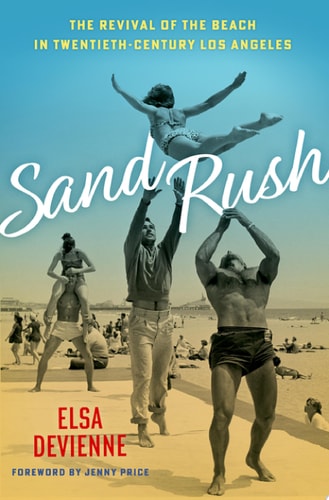
Sand Rush: The Revival of the Beach in Twentieth-Century Los Angeles
0
0
As an Amazon Associate and affiliate partner, Menrva Books earns from qualifying purchases. Learn more
Author Description
The first history of the formidable campaign that transformed Los Angeles into one of the world's greatest coastal metropolises, revealing how the city's man-made shores became the site for the reinvention of seaside leisure and the triumph of modern bodies.The Los Angeles shoreline is one of the most iconic natural landscapes in the United States, if not the world. The vast shores of Santa Monica, Venice, and Malibu are familiar sights to film and television audiences, conveying images of pristine sand, carefree fun, and glamorous physiques. Yet, in the early twentieth century Angelenos routinely lamented the city's crowded, polluted, and eroded sands, many of which were private and thus inaccessible to the public.Between the 1920s and the 1960s, LA's engineers, city officials, urban planners, and business elite worked together to transform the relatively untouched beaches into modern playgrounds for the white middle class. They cleaned up and enlarged the beaches--up to three times their original size--and destroyed old piers and barracks to make room for brand-new accommodations, parking lots, and freeways. The members of this powerful "beach lobby" reinvented the beach experience for the suburban age, effectively preventing a much-feared "white flight" from the coast. In doing so, they established Southern California as the national reference point for shoreline planning and coastal access. As they opened up vast public spaces for many Angelenos to express themselves, show off their bodies, and forge alternative communities, they made clear that certain groups of beachgoers, including African Americans, gay men and women, and bodybuilders, were no longer welcome. Despite their artificial origins, LA's beaches have proved remarkably resilient. The drastic human interventions into nature brought social and economic benefits to the region without long-term detrimental consequences on the environment. Yet the ongoing climate crisis and rapid sea level rise will even
Menrva's Summary
THE THESIS
How did the deliberate engineering of the Los Angeles coastline between the 1920s and 1960s reshape the city's social, economic, and physical landscape? Elsa Devienne examines the intersection of urban development, public policy, and social exclusion to argue that the iconic beaches of Los Angeles are largely artificial constructs. By analyzing the efforts of the city's "beach lobby," the author demonstrates how these spaces were curated to serve specific demographic groups while systematically marginalizing others. The work provides a critical look at the tension between human intervention in natural environments and the resulting socio-political consequences.
THE SCOPE MAP
What You Will Find
- Historical analysis of the transformation of Santa Monica, Venice, and Malibu shorelines.
- Examination of the "beach lobby" coalition consisting of engineers, urban planners, and business elites.
- Investigation into the exclusionary practices targeting African Americans, gay communities, and other groups.
- Discussion on the long-term environmental resilience of man-made coastal infrastructure in the face of climate change.
THE AUTHORITY PERSPECTIVE
Scholars and urban historians identify this work as a significant contribution to the study of Southern California's development and coastal management. Readers frequently note the meticulous archival research that exposes the political motivations behind the creation of these public spaces.
Page Count:
328
Publication Date:
2024-01-01
Publisher:
Oxford University Press
ISBN-10:
0197539750
ISBN-13:
9780197539750
History
California
Sociology
Geography
Environmental History
America history
urban planning
Community Tags
Other Editions(2)

Similar Books








Reader Comments
Share Your Thoughts
No comments yet. Be the first to share your thoughts!