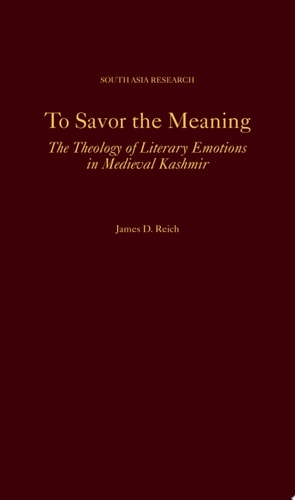
To Savor the Meaning: The Theology of Literary Emotions in Medieval Kashmir
0
0
As an Amazon Associate and affiliate partner, Menrva Books earns from qualifying purchases. Learn more
Author Description
Medieval Kashmir in its golden age saw the development of some of the most sophisticated theories of language, literature, and emotion articulated in the pre-modern world. These theories, enormously influential on the later intellectual history of South Asia, were written at a time when religious education was ubiquitous among intellectuals, and when religious philosophies were hotly and publicly debated. It was also a time of deep interreligious influence and borrowing, when traditions intermixed and intellectuals pushed the boundaries of their own inheritance by borrowing ideas from many different places-even from their rivals. To Savor the Meaning examines the overlap of literary theory and religious philosophy in this period by looking at debates about how poetry communicates emotions to its readers, what it is readers do when they savor these emotions, and why this might be valuable. Focusing on the work of three influential figures-Anandavardhana [ca. 850 AD], Abhinavagupta [ca. 1000 AD], and the somewhat lesser known theorist Mahimabhatta [ca. 1050 AD]-this book gives a broad introduction to their ideas and reveals new, important, and previously overlooked aspects of their work and their debates. James D. Reich places these pre-modern intellectuals within the wider context of the religious philosophies current in Kashmir at the time, and shows that their ideas cannot be fully understood in isolation from this broader context.
Menrva's Summary
THE THESIS
This book investigates the intersection of literary theory and religious philosophy in medieval Kashmir to determine how pre-modern intellectuals conceptualized the communication and reception of emotional meaning in poetry. James D. Reich, a scholar of South Asian intellectual history, utilizes a comparative framework to analyze the works of Anandavardhana, Abhinavagupta, and Mahimabhatta. By situating these theorists within the broader religious debates of their era, the author argues that their aesthetic theories were deeply informed by, and inseparable from, the prevailing religious philosophies of the time.
THE SCOPE MAP
What You Will Find
- Analysis of the aesthetic theories of Anandavardhana, Abhinavagupta, and Mahimabhatta.
- Examination of the interreligious influence and intellectual borrowing prevalent in medieval Kashmir.
- A contextual study of how religious education and public debate shaped literary criticism.
- Exploration of the concept of 'savoring' emotions within the framework of pre-modern South Asian literature.
THE AUTHORITY PERSPECTIVE
Scholars and students of South Asian intellectual history recognize this work as a significant contribution to the understanding of Kashmiri aesthetic theory. Readers frequently note the academic density of the prose, which provides a rigorous examination of complex philosophical debates for those interested in the history of ideas.
Page Count:
279
Publication Date:
2021-01-01
Publisher:
Oxford University Press
ISBN-10:
0197544851
ISBN-13:
9780197544853
Philosophy
History
Religion
Asian History
Literary Criticism
European History
Community Tags
Other Editions(2)
Similar Books