Author Description
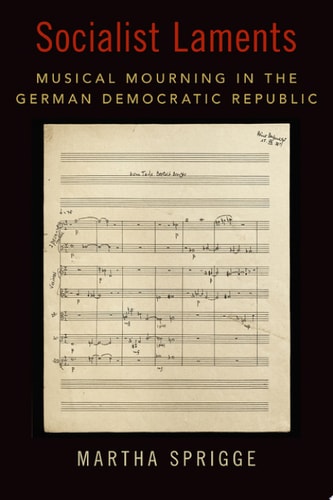
Antifascist and socialist monuments pervaded the landscape of the former German Democratic Republic (1949-89), presenting a distorted vision of the national past. Official commemorative culture in East Germany celebrated a selective set of political heroes, seeming to leave no public space for mourning those who were excluded from the country's founding myths. Socialist Laments: Musical Mourning in the German Democratic Republic examines the role of music in this nation's memorial culture, demonstrating how music facilitated the expressions of loss within spaces of commemoration for East German citizens. Music performed during state-sponsored memorial rituals no doubt bolstered official narratives of the German past. But it simultaneously provided an outlet for mourning in highly politicized environment. The book presents both a history and theory of musical mourning in East Germany. Using a site-specific approach to analysis, author Martha Sprigge demonstrates how the multiple semantic networks opened up by these musical works facilitated many memorial associations without necessitating the overt articulation of a mourned subject. Throughout the country's forty-year existence, music offered East German citizens an audible outlet for working through traumatic losses-both collective and individual-that was distinct from other artistic expressive possibilities. The book reveals the ways that East Germany's extensive commemorative repertoire helped composers, performers, and audiences navigate between the inevitable need to mourn on the one hand, and the seeming impossibilities of mourning on the other.
Menrva's Summary
THE THESIS
How did music function as a mechanism for mourning within the highly politicized and restrictive commemorative culture of the German Democratic Republic? Martha Sprigge, a scholar of musicology, utilizes a site-specific analytical framework to investigate the intersection of state-sponsored memorial rituals and private expressions of loss. By examining the semantic networks inherent in musical compositions, the author argues that music provided East German citizens with a unique, audible outlet for processing trauma that bypassed the limitations of official state narratives. The work synthesizes historical documentation with musicological theory to reveal how composers and audiences navigated the tension between state-mandated memory and the human necessity for grief.
THE SCOPE MAP
What You Will Find
- A comprehensive analysis of musical mourning practices within the German Democratic Republic from 1949 to 1989.
- A theoretical framework for understanding how music facilitates memorial associations in restrictive political environments.
- Case studies of state-sponsored memorial rituals and the specific musical repertoires utilized therein.
- An exploration of the interplay between collective state myths and individual experiences of traumatic loss.
THE AUTHORITY PERSPECTIVE
Scholars in the fields of musicology and German history identify this text as a significant contribution to the study of East German cultural life. Readers frequently note the academic density of the prose, which effectively bridges the gap between historical analysis and music theory to provide a nuanced view of life under the GDR regime.
Page Count:
374
Publication Date:
2021-01-01
Publisher:
Oxford University Press
ISBN-10:
019754634X
ISBN-13:
9780197546345
History
Music
Humanities
Music History
Criticism history
European History
Community Tags
Similar Books