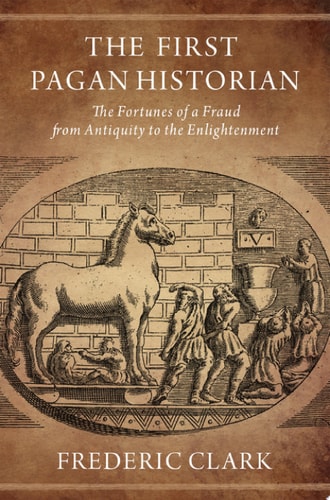
The First Pagan Historian: The Fortunes of a Fraud from Antiquity to the Enlightenment
0
0
As an Amazon Associate and affiliate partner, Menrva Books earns from qualifying purchases. Learn more
Author Description
In The History of the Destruction of Troy, Dares the Phrygian boldly claimed to be an eyewitness to the Trojan War, while challenging the accounts of two of the ancient world's most canonical poets, Homer and Virgil. For over a millennium, Dares' work was circulated as the first pagan history. It promised facts and only facts about what really happened at Troy — precise casualty figures, no mention of mythical phenomena, and a claim that Troy fell when Aeneas and other Trojans betrayed their city and opened its gates to the Greeks. But for all its intrigue, the work was as fake as it was sensational. From the late antique encyclopedist Isidore of Seville to Thomas Jefferson, The First Pagan Historian offers the first comprehensive account of Dares' rise and fall as a reliable and canonical guide to the distant past. Along the way, it reconstructs the central role of forgery in longstanding debates over the nature of history, fiction, criticism, philology, and myth, from ancient Rome to the Enlightenment.
Menrva's Summary
THE THESIS
This book investigates how a fraudulent account of the Trojan War, attributed to Dares the Phrygian, maintained its status as a canonical historical text for over a millennium. Frederic Clark, a scholar of intellectual history, examines the reception of this forgery from late antiquity through the Enlightenment. By tracing the shifting interpretations of Dares' work, the author argues that the persistence of this text reveals fundamental tensions in how Western culture has defined the boundaries between historical fact, myth, and literary invention.
THE SCOPE MAP
What You Will Find
- A detailed examination of the reception history of 'The History of the Destruction of Troy' across fifteen centuries.
- An analysis of the intellectual methods used by scholars, from Isidore of Seville to Thomas Jefferson, to validate or debunk historical claims.
- A study of the role of forgery in the development of philology and critical historical inquiry.
- A thematic exploration of how societies reconcile the desire for factual accuracy with the cultural importance of legendary narratives.
THE AUTHORITY PERSPECTIVE
Experts recognize this work as a significant contribution to the history of scholarship and the evolution of historical methodology. Readers frequently note the academic density of the prose, which provides a rigorous look at how intellectual traditions are constructed and dismantled over time.
Page Count:
366
Publication Date:
2020-01-01
Publisher:
Oxford University Press
ISBN-10:
0197540724
ISBN-13:
9780197540725
History
Philosophy
Ancient History
European History
Historiography
Literary Criticism
English & College Success
English
Community Tags
Similar Books