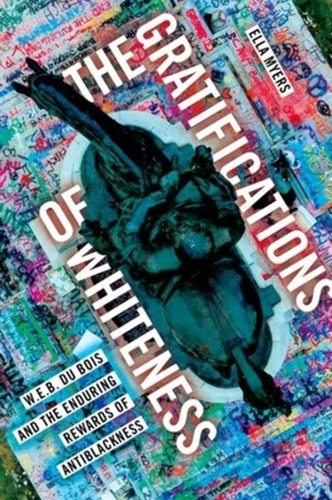
The Gratifications of Whiteness: W. E. B. Du Bois and the Enduring Rewards of Anti-Blackness
0
0
As an Amazon Associate and affiliate partner, Menrva Books earns from qualifying purchases. Learn more
Author Description
The first book-length study of W. E. B. Du Bois's conceptualization of American whiteness.W. E. B. Du Bois famously argued that whiteness in the US in the late nineteenth and early twentieth centuries functioned as a "public and psychological wage," offering valuable social standing to even the poorest of whites. Such "compensation," dependent on the devaluation of Black existence, helped secure the US capitalist regime and prevent interracial class solidarity. This book argues that Du Bois's influential account of compensatory whiteness is crucially important, but also incomplete. For Du Bois, whiteness was never one thing, but many. Focusing on Du Bois's middle-period work (about 1920-1940), Ella Myers uncovers an overlooked, complex analysis that theorizes whiteness as a source of varied gratifications. These gratifications include not only the status rewards of racial capitalism, but also the enjoyment of gratuitous Black suffering and the conviction that the planet belongs to those marked as "white." The book shows that Du Bois's analysis, developed in response to the pressing political problems of his own day, also offers insight into 21st century struggles for racial justice. Myers argues that it is important to recognize the extent to which anti-Blackness continues to underwrite plural -and deeply disturbing-forms of white gratification here and now. Doing so helps explain the tenacity of America's unequal racial order and also reveals why creative, multifaceted strategies of resistance are necessary to end it.
Menrva's Summary
THE THESIS
How does W. E. B. Du Bois's conceptualization of whiteness as a system of varied gratifications explain the persistence of anti-Blackness in the modern era? Ella Myers, a scholar of political theory, examines Du Bois's middle-period writings to expand upon his famous theory of the 'public and psychological wage.' She argues that whiteness functions not merely as a status reward, but as a multifaceted system that includes the enjoyment of suffering and a sense of planetary entitlement, providing a framework for understanding contemporary racial inequality.
THE SCOPE MAP
What You Will Find
- Analysis of W. E. B. Du Bois's middle-period works spanning 1920 to 1940.
- Theoretical exploration of whiteness as a source of varied psychological and social gratifications.
- Examination of the intersection between racial capitalism and the devaluation of Black existence.
- Application of historical political theory to 21st-century struggles for racial justice.
THE AUTHORITY PERSPECTIVE
Scholars and critics identify this work as a significant contribution to the study of Du Bois's political thought and the mechanics of racial hierarchy. Readers frequently note the academic density of the prose, which is well-suited for advanced students and researchers in political theory and sociology.
Page Count:
256
Publication Date:
2022-09-28
Publisher:
Oxford University Press
ISBN-10:
0197556779
ISBN-13:
9780197556771
History
Philosophy
United States
Sociology
Race Relations
American Studies
Community Tags
Similar Books