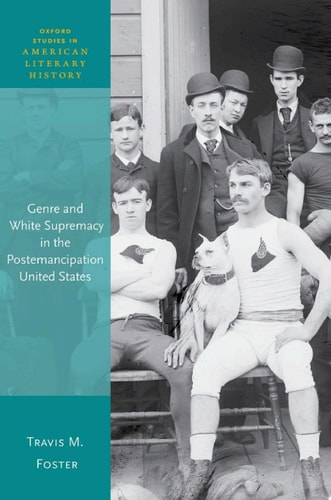
Genre and White Supremacy in the Postemancipation United States
0
0
As an Amazon Associate and affiliate partner, Menrva Books earns from qualifying purchases. Learn more
Author Description
How are we to comprehend, diagnose, and counter a system of racist subjugation so ordinary it has become utterly asymptomatic? Challenging the prevailing literary critical inclination toward what makes texts exceptional or distinctive, Genre and White Supremacy in the Postemancipation United States underscores the urgent importance of genre for tracking conventionality as it enters into, constitutes, and reproduces ordinary life. In the wake of emancipation's failed promise, two developments unfolded: white supremacy amassed new mechanisms and procedures for reproducing racial hierarchy; and black freedom developed new practices for collective expression and experimentation. This new racial ordinary came into being through new literary and cultural genres--including campus novels, the Ladies' Home Journal, Civil War elegies, and gospel sermons. Through the postemancipation interplay between aesthetic conventions and social norms, genre became a major influence in how Americans understood their social and political affiliations, their citizenship, and their race. Travis M. Foster traces this thick history through four decades following the Civil War, equipping us to understand ordinary practices of resistance more fully and to resist ordinary procedures of subjugation more effectively. In the process, he provides a model for how the study of popular genre can reinvigorate our methods for historicizing the everyday.
Menrva's Summary
THE THESIS
This book investigates how literary and cultural genres functioned as mechanisms to normalize and reproduce white supremacy in the United States during the four decades following the Civil War. Travis M. Foster, an academic specializing in American literary history, argues that the study of conventional, popular genres provides a critical lens for understanding how racial hierarchies were embedded into the fabric of everyday life. By examining the interplay between aesthetic conventions and social norms, the author demonstrates how genre shaped American concepts of citizenship, political affiliation, and racial identity.
THE SCOPE MAP
What You Will Find
- Analysis of diverse genres including campus novels, women's magazines, elegies, and sermons.
- A framework for tracking how conventionality reproduces social structures.
- Historical examination of the post-Civil War era's racial landscape.
Scope Limits
- The study focuses primarily on the four decades immediately following the Civil War.
- The analysis prioritizes popular and conventional texts over exceptional or canonical literary works.
THE AUTHORITY PERSPECTIVE
Scholars in the field of American literary history identify this work as a significant contribution to the study of how popular culture reinforces systemic social structures. Readers frequently note the academic density of the prose and the author's rigorous methodology in connecting aesthetic form to political history.
Page Count:
176
Publication Date:
2019-01-01
Publisher:
OUP Oxford
ISBN-10:
0192575171
ISBN-13:
9780192575173
History
Sociology
English & College Success
American Studies
Race Relations
English
Literary Criticism