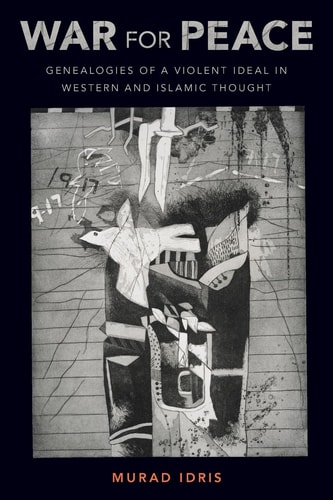
War for Peace: Genealogies of a Violent Ideal in Western and Islamic Thought
0
0
As an Amazon Associate and affiliate partner, Menrva Books earns from qualifying purchases. Learn more
Author Description
Peace is a universal ideal, but its political life is a great paradox: "peace" is the opposite of war, but it also enables war. If peace is the elimination of war, then what does it mean to wage war for the sake of peace? What does peace mean when some say that they are committed to it but that their enemies do not value it? Why is it that associating peace with other ideals, like justice, friendship, security, and law, does little to distance peace from war?Although political theory has dealt extensively with most major concepts that today define "the political" it has paid relatively scant critical attention to peace, the very concept that is often said to be the major aim and ideal of humanity. In War for Peace, Murad Idris looks at the ways that peace has been treated across the writings of ten thinkers from ancient and modern political thought, from Plato to Immanuel Kant and Sayyid Qutb, to produce an original and striking account of what peace means and how it works. Idris argues that peace is parasitical in that the addition of other ideals into peace, such as law, security, and friendship, reduces it to consensus and actually facilitates war; it is provincial in that its universalized content reflects particularistic desires and fears, constructions of difference, and hierarchies within humanity; and it is polemical, in that its idealization is not only the product of antagonisms, but also enables hostility. War for Peace uncovers the basis of peace's moralities and the political functions of its idealizations, historically and into the present. This bold and ambitious book confronts readers with the impurity of peace as an ideal, and the pressing need to think beyond universal peace.
Menrva's Summary
THE THESIS
This book investigates the inherent paradox of peace as a political ideal, questioning how a concept defined by the absence of war frequently serves as a justification for its continuation. Murad Idris, a scholar of political theory, examines the genealogy of peace across diverse intellectual traditions, including Western and Islamic thought. He argues that peace is often treated as a parasitical, provincial, and polemical construct that, when paired with ideals like security or justice, functions to facilitate rather than eliminate conflict.
THE SCOPE MAP
What You Will Find
- A comparative analysis of ten major thinkers spanning from Plato to Immanuel Kant and Sayyid Qutb.
- A critical framework for understanding how peace is utilized as a tool for political hierarchy and the construction of difference.
- Historical and contemporary case studies demonstrating the polemical nature of peace in political discourse.
- An exploration of the linguistic and conceptual mechanisms that allow peace to function as a catalyst for hostility.
THE AUTHORITY PERSPECTIVE
Scholars and political theorists recognize this work as a rigorous intervention in the study of political concepts, noting its ability to bridge Western and Islamic intellectual traditions. Readers frequently highlight the dense, analytical prose and the author's challenging critique of universalist peace narratives.
Page Count:
354
Publication Date:
2020-12-02
Publisher:
Oxford University Press
ISBN-10:
019757680X
ISBN-13:
9780197576809
Philosophy
History
War Philosophy
International relations
Political Theory
Comparative Politics
Islamic Studies
Community Tags
Similar Books