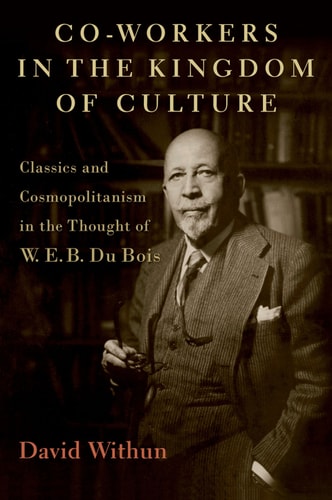
Co-workers in the Kingdom of Culture: Classics and Cosmopolitanism in the Thought of W. E. B. Du Bois
0
0
As an Amazon Associate and affiliate partner, Menrva Books earns from qualifying purchases. Learn more
Author Description
W. E. B. Du Bois was one of the great African American intellectuals of the early twentieth century. He was a prominent civil rights leader, sociologist, historian, educator, author of several works of fiction, and one of the founding figures of Pan-Africanism. Du Bois's works are filled with allusions to the classical mythology, philosophy, and history that permeated his education. In the first book-length discussion of the topic, David Withun examines the influence of classical authors on Du Bois's thoughts about education, the arts, government, and society. The influence of classical philosophy, particularly that of Plato and Cicero, is apparent in some of Du Bois's most distinctive ideas, such as the concept of the Talented Tenth, his opposition to Booker T. Washington's industrial education, and in his support of propaganda through art.Withun also explores Du Bois's critique of the classical tradition in his responses to modern racism and colonialism. While Du Bois adopted a number of ideas from the classical tradition, he also used them to critique what he saw as a tradition gone awry. Alongside Du Bois's critique of the classical tradition, he also exhibited an increasing interest in the history--ancient and modern--of Africa and Asia. In his attempts to combat modern prejudice, Du Bois appealed to the long traditions of thought of peoples outside of Europe, in several instances pioneering the research of non-European history. Withun argues that Du Bois's absorption of the classical tradition and simultaneous appreciation of the history of Africa and Asia culminated in a modern cosmopolitanism, one that calls for a more inclusive appreciation of global culture.
Menrva's Summary
THE THESIS
This book investigates how W. E. B. Du Bois integrated classical Western philosophy with a global, cosmopolitan perspective to challenge racial prejudice and colonial structures. David Withun, an academic researcher, analyzes the intellectual development of Du Bois by tracing his reliance on and critique of classical authors like Plato and Cicero. The book argues that Du Bois utilized these classical foundations to formulate his theories on the Talented Tenth, educational reform, and the role of art in social progress. By synthesizing these influences with his growing interest in African and Asian history, Withun demonstrates how Du Bois constructed a modern, inclusive framework for global culture.
THE SCOPE MAP
What You Will Find
- Analysis of classical influences including Plato and Cicero on Du Bois's political and educational theories.
- Examination of the tension between Western classical traditions and the critique of modern colonialism.
- Discussion of Du Bois's pioneering research into the histories of Africa and Asia as a counter-narrative to Eurocentrism.
- Evaluation of the concept of the Talented Tenth and the role of propaganda in art.
THE AUTHORITY PERSPECTIVE
Experts recognize this work as the first comprehensive study dedicated to the intersection of classical antiquity and the intellectual output of W. E. B. Du Bois. Scholars frequently note the academic rigor of the text, highlighting its utility for those interested in the history of ideas and the evolution of twentieth-century civil rights thought.
Page Count:
252
Publication Date:
2021-01-01
Publisher:
Oxford University Press
ISBN-10:
0197579604
ISBN-13:
9780197579602
Biography
History
Philosophy
Sociology
Education
English
Modern History
Classicism
Civilization
History & Surveys
United States
Ancient History
English & College Success
Community Tags
Similar Books