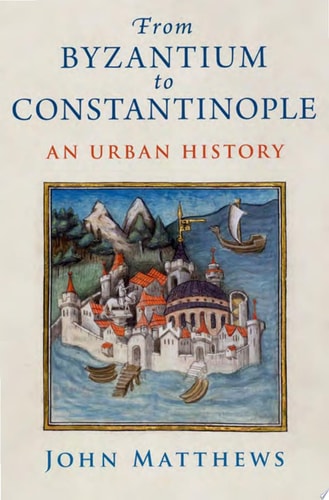
From Byzantium to Constantinople: An Urban History
0
0
As an Amazon Associate and affiliate partner, Menrva Books earns from qualifying purchases. Learn more
Author Description
The consecration of the city of Constantinople in 330 CE on the emplacement of the Greek city of Byzantium was one of the most important moments in the whole of Graeco-Roman history. The foundation of the city responded to important changes in the social, political, and cultural character of the Roman empire of the first three centuries. In its role as the capital of the Byzantine Empire, it provided a setting for a new religion and the framework for more than a thousand years of continued Roman history in the east. From Byzantium to Constantinople explores, in great detail, the Graeco-Roman context of the city and its early history in the first century of its identity as the new Rome.The book surveys the events that led to the establishment of Constantinople, the circumstances of its foundation, and the first hundred years of its development as an imperial capital city resting upon a new religious identity. Based on a description and critical evaluation of the sources of the earlier history of the city of Byzantium, it attends to one document in particular--the Notitia Urbis Constantinopolitanae--a regional survey of the resources and monuments of the city, written in the early fifth century but preserving many details of the city as it had developed from its Greek and Roman background. Ranging from descriptions of Constantinople's facilities for the fighting of fires and distributions of bread, to the number of churches established in this period, the Notitia allows for a study of the economic and social diversity and housing conditions of its regions.Constantinople, the new Rome founded by the first Christian emperor, was not built in a day nor did it lack an earlier history as an important city in a strategic location. The integration of these diverse and variously problematic sources enables the foundation of Constantinople to be understood in terms of a developing understanding of its role, and as a series of initiatives that could be accommodated by the resou
Menrva's Summary
THE THESIS
This work investigates the transformation of the Greek city of Byzantium into the imperial capital of Constantinople, examining how this transition reflected the shifting social, political, and religious landscape of the late Roman Empire. John A. Matthews utilizes a critical evaluation of primary source materials, specifically the Notitia Urbis Constantinopolitanae, to reconstruct the city's early development. By analyzing the infrastructure, administrative resources, and cultural integration of the new capital, the author argues that the city's foundation was a complex, multi-layered process rather than a singular event.
THE SCOPE MAP
What You Will Find
- An analysis of the Notitia Urbis Constantinopolitanae as a primary source for urban resource management.
- A survey of the socioeconomic conditions, including bread distribution and fire-fighting infrastructure, in the early fifth century.
- A historical examination of the transition from a Greek city to the Christian imperial capital of the East.
- An evaluation of the architectural and religious developments during the city's first hundred years.
THE AUTHORITY PERSPECTIVE
Scholars recognize this text as a rigorous examination of the administrative and urban history of early Constantinople. Readers frequently note the academic density of the prose, which relies heavily on the interpretation of regional surveys and historical documentation.
Page Count:
280
Publication Date:
2024-12-05
Publisher:
Oxford University Press
ISBN-10:
0197585493
ISBN-13:
9780197585498
History
Roman Empire
Urban History
Byzantine History
Ancient History
Europe
Community Tags
Similar Books