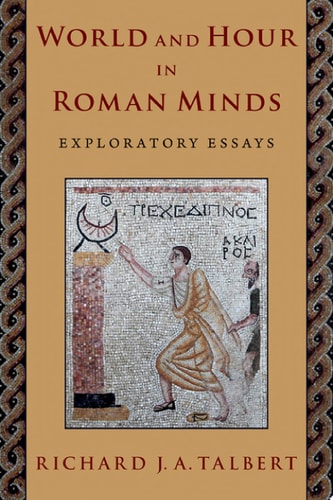
World and Hour in Roman Minds: Exploratory Essays
0
0
As an Amazon Associate and affiliate partner, Menrva Books earns from qualifying purchases. Learn more
Author Description
World and Hour in Roman Minds: Exploratory Essays seeks to penetrate Romans' consciousness of space and time, aspects of antiquity currently attracting intense interest. Historian Richard Talbert presents here a cohesive selection of nineteen essays, published over the course of thirty years, all but one previously appearing in widely scattered publications. Now reinforced by an Introduction and textually and visually updated, these essays document the progress of pioneering efforts to glimpse the worldviews of Romans up and down the social scale--even Julius Caesar and Claudius--and to reassess the communicative role of Roman mapping along with its strengths and limitations.Talbert interprets the Antonine Itinerary and Artemidorus and Peutinger maps afresh, visualizing the latter with a wider perspective than in previous scholarship and probing the challenges of its design, production and copying. He also casts doubt, however, on the idea that Romans conceptualized their long-distance roads as an interconnected system, as did certain comparable premodern states across the Americas and Asia.The most recent essays share findings that emerge with a shift of focus from space to time, specifically Romans' daily timekeeping by hours--another neglected dimension of their social mentalité. Talbert suggests that Romans' tracking of time should be regarded as uncannily similar to that of the Japanese before Westernization. Throughout, the essays are unified by the methods applied. The value of broader, often comparative, approaches is demonstrated, as well as the creative potential of untapped testimony and digital technology--altogether an invaluable platform to stimulate further inquiry.
Menrva's Summary
THE THESIS
This collection of essays investigates how the Roman population, from common citizens to political leaders, conceptualized their understanding of space and time. Historian Richard J. A. Talbert utilizes three decades of research to examine Roman worldviews, focusing on the practical application of mapping and the social mentalité regarding timekeeping. By synthesizing archaeological evidence, cartographic analysis, and comparative historical studies, Talbert argues that Roman spatial and temporal perceptions were more complex and distinct than traditional scholarship has previously acknowledged.
THE SCOPE MAP
What You Will Find
- Analysis of primary cartographic artifacts including the Antonine Itinerary, the Artemidorus papyrus, and the Peutinger map.
- Examination of Roman road networks and the challenge to the theory of an interconnected imperial system.
- Comparative studies between Roman timekeeping practices and pre-modern Japanese temporal systems.
- Methodological applications of digital technology and untapped testimony to reconstruct ancient consciousness.
THE AUTHORITY PERSPECTIVE
Scholars recognize this collection as a significant contribution to the study of Roman social history and ancient cartography. Experts frequently note the academic density of the prose and the value of Talbert's comparative approach in challenging established historical assumptions.
Page Count:
326
Publication Date:
2023-01-01
Publisher:
Oxford University Press
ISBN-10:
0197606369
ISBN-13:
9780197606360
History
Ancient History
Roman History
World Civilization
Social History
Italy history
Earth Sciences
Cartography
Essays
Community Tags
Other Editions(2)

Similar Books