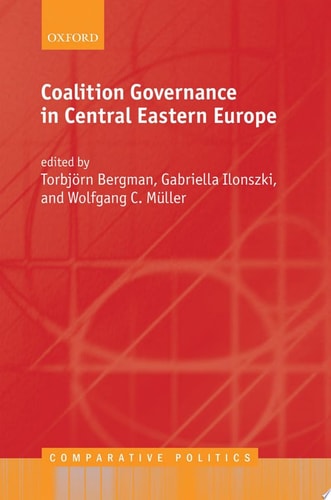
Coalition Governance in Central Eastern Europe
0
0
As an Amazon Associate and affiliate partner, Menrva Books earns from qualifying purchases. Learn more
Author Description
Coalition Government Among Different Political Parties Is The Way Most European Democracies Are Governed. Traditionally, The Study Of Coalition Politics Has Been Focused On Western Europe. Coalition Governance In Central Eastern Europe Brings The Study Of The Full Coalition Life-cycle To A Region That Has Undergone Tremendous Political Transformation, But Which Has Not Been Studied From This Perspective. The Volume Covers Bulgaria, Estonia, The Czech Republic, Latvia, Lithuania, Hungary, Poland, Romania, Slovakia, And Slovenia. It Provides Information And Analyses Of The Coalition Life-cycle, From Pre-electoral Alliances To Coalition Formation And Portfolio Distribution, Governing In Coalitions, The Stages That Eventually Lead To Government Termination, And The Electoral Performance Of Coalition Parties. In Central Eastern Europe, Few Single-party Cabinets Form And There Have Been Only A Few Early Elections. The Evidence Provided Shows That Coalition Partners In The Region Write Formal Agreements (coalition Agreements) To An Extent That Is Similar To The Patterns That We Find In Western Europe, But Also That They Adhere Less Closely To These Contracts. While The Research On Western Europe Tends To Stress That Coalition Partners Emphasize Coalition Compromise And Mutual Supervision, There Is More Evidence Of 'ministerial Government' By Individual Ministers And Their Parties. There Are Also Some Systems Where Coalition Governance Is Heavily Dominated By The Prime Minister. No Previous Study Has Covered The Full Coalition Life-cycle In All Of The Ten Countries With As Much Detail. Systematic Information Is Presented In 10 Figures And In More Than One Hundred Tables. Comparative Politics Is A Series For Researchers, Teachers, And Students Of Political Science That Deals With Contemporary Government And Politics. Global In Scope, Books In The Series Are Characterised By A Stress On Comparative Analysis And Strong Methodological Rigour. The Series Is Published In Associat
Menrva's Summary
THE THESIS
This volume investigates the mechanics of coalition governance within Central Eastern European democracies, questioning how these systems function across the full political life-cycle compared to established Western European models. The authors, Gabriella Ilonszki, Torbjörn Bergman, and Wolfgang C. Müller, utilize extensive comparative data to analyze political transformation in ten post-communist states. Their framework examines the transition from pre-electoral alliances through government formation, portfolio distribution, and eventual termination, challenging existing assumptions about ministerial autonomy and contract adherence in the region.
THE SCOPE MAP
What You Will Find
- Comparative analysis of coalition life-cycles in Bulgaria, Estonia, the Czech Republic, Latvia, Lithuania, Hungary, Poland, Romania, Slovakia, and Slovenia.
- Quantitative data presented in over one hundred tables and ten figures.
- Examination of formal coalition agreements versus actual governing practices.
Scope Limits
- The study focuses primarily on the specified ten Central Eastern European nations and does not provide an exhaustive analysis of Western European coalition politics beyond comparative reference points.
THE AUTHORITY PERSPECTIVE
Experts recognize this work as a foundational comparative study for scholars and students of political science focusing on post-communist governance. Readers frequently note the high density of empirical data and the methodological rigor applied to the analysis of coalition stability and ministerial behavior.
Page Count:
624
Publication Date:
2019-01-01
Publisher:
Oxford University Press
ISBN-10:
0192582712
ISBN-13:
9780192582713
Public Policy
Comparative Politics
Government
Community Tags
Other Editions(2)
Similar Books









Reader Comments
Share Your Thoughts
No comments yet. Be the first to share your thoughts!