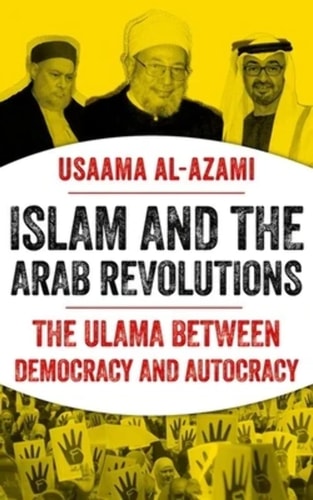
Islam and the Arab Revolutions: The Ulama Between Democracy and Autocracy
0
0
As an Amazon Associate and affiliate partner, Menrva Books earns from qualifying purchases. Learn more
Author Description
The Arab revolutions of 2011 were a transformative moment in the modern history of the Middle East, as people rose up against long-standing autocrats throughout the region to call for 'bread, freedom and dignity'. With the passage of time, results have been decidedly mixed, with tentative success stories like Tunisia contrasting with the emergence of even more repressive dictatorships in places like Egypt, with the backing of several Gulf states.Focusing primarily on Egypt, this book considers a relatively understudied dimension of these revolutions: the role of prominent religious scholars. While pro-revolutionary ulama have justified activism against authoritarian regimes, counter-revolutionary scholars have provided religious backing for repression, and in some cases the mass murder of unarmed protestors.Usaama al-Azami traces the public engagements and religious pronouncements of several prominent ulama in the region, including Yusuf al-Qaradawi, Ali Gomaa and Abdullah bin Bayyah, to explore their role in either championing the Arab revolutions or supporting their repression. He concludes that while a minority of noted scholars have enthusiastically endorsed the counter-revolutions, their approach is attributable less to premodern theology and more to their distinctly modern commitment to the authoritarian state.
Menrva's Summary
THE THESIS
This book investigates the pivotal role of prominent religious scholars in shaping the political outcomes of the 2011 Arab revolutions. Usaama Al-Azami, a scholar of contemporary Islamic thought, utilizes a comparative analysis of religious pronouncements and public engagements to examine how the ulama influenced the struggle between democratic aspirations and authoritarian stability. By focusing on key figures such as Yusuf al-Qaradawi, Ali Gomaa, and Abdullah bin Bayyah, the author argues that the support for counter-revolutionary repression is rooted in modern political commitments rather than traditional theological frameworks.
THE SCOPE MAP
What You Will Find
- A detailed examination of the 2011 Arab revolutions with a primary focus on the Egyptian political landscape.
- An analysis of the public discourse and religious justifications provided by influential ulama during periods of civil unrest.
- A comparative study of how religious authority is leveraged to either challenge or reinforce state-led authoritarianism.
- Evidence derived from primary source religious pronouncements, public statements, and political engagements of key Islamic scholars.
THE AUTHORITY PERSPECTIVE
Experts recognize this work as a significant contribution to the study of modern Islamic political thought and the intersection of religion and state power in the Middle East. Scholars frequently highlight the text for its nuanced approach to the ideological motivations of the ulama, noting its importance for understanding the complexities of post-2011 political developments.
Page Count:
392
Publication Date:
2022-06-15
Publisher:
Oxford University Press
ISBN-10:
0197613616
ISBN-13:
9780197613610
History
Religion
Sociology
Middle East
Islam
Community Tags
Similar Books