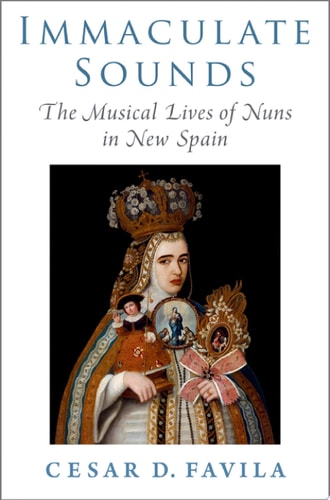
Immaculate Sounds: The Musical Lives of Nuns in New Spain
0
0
As an Amazon Associate and affiliate partner, Menrva Books earns from qualifying purchases. Learn more
Author Description
In Catholic doctrine, the Immaculate Conception of the Virgin Mary is the belief that Mary, the mother of Christ, was exempt from original sin from the moment of her conception, and thereby a co-redeemer alongside her son. Praise for this complicated devotion took place in Europe throughout the medieval period and resounded in the Americas with the founding of the first convent in Mexico City under the Order of the Immaculate Conception in 1540. All other orders of nuns in New Spain branched out from this convent, spreading the Marian devotion throughout the region.In this book, author Cesar D. Favila argues that the sonification of virginity and the Virgin Mary was fundamental to the promotion of the Immaculate Conception doctrine, and that this was part of a complex network of sonified practices in the lives of New Spanish nuns. These "immaculate sounds," a term Favila uses for the cloistered nuns' idealized vocalizations as well as the expression of doctrinal rhetoric through musical metaphors, echoed the highly regulated realm of the convent and played a pivotal role in mediating between the lives of New Spanish nuns and the expectation that they would save the secular world with their vocalized prayers. In addition to the sonification of discipline, Favila shows that immaculate sounds also enhanced the nuns' engagement with their religious practices and facilitated embodied and spiritual engagement with Catholic doctrines.Throughout his study, he delves into rarely studied music sources from seventeenth- and eighteenth-century New Spain alongside the rulebooks, devotional literature, and nuns' biographies that regulated convent life and inspired nuns' hymns. In doing so, Favila brings together a narrative of salvation that shines a light on the musical lives of nuns and locates women's agency within a hierarchical society that silenced some women and required others to sing.This is an open access title available under the terms of a CC BY-NC-ND 4.0 Internationa
Menrva's Summary
THE THESIS
This book investigates how the musical practices of cloistered nuns in colonial New Spain functioned as a critical mechanism for promoting the doctrine of the Immaculate Conception. Author Cesar D. Favila, a scholar of Latin American music, utilizes a multidisciplinary approach to argue that the vocalizations of these women were not merely devotional but served as a complex system of sonified rhetoric. By examining the intersection of convent discipline and musical performance, Favila demonstrates how these sounds mediated the relationship between the cloistered religious life and the secular world's expectations of spiritual salvation.
THE SCOPE MAP
What You Will Find
- Analysis of seventeenth
- and eighteenth-century musical manuscripts from New Spain.
- Examination of rulebooks, devotional literature, and biographical accounts of nuns.
- Exploration of the theological connection between vocal performance and the Immaculate Conception.
- Investigation into the agency of women within the rigid hierarchies of colonial religious institutions.
THE AUTHORITY PERSPECTIVE
Scholars recognize this work as a significant contribution to the study of colonial music and gendered religious practice. Readers frequently note the academic rigor of the research and the author's ability to synthesize archival documents with musicological theory.
Page Count:
360
Publication Date:
2023-01-01
Publisher:
Oxford University Press
ISBN-10:
0197621899
ISBN-13:
9780197621899
History
Mexico history
Music History
Church music
Community Tags
Similar Books