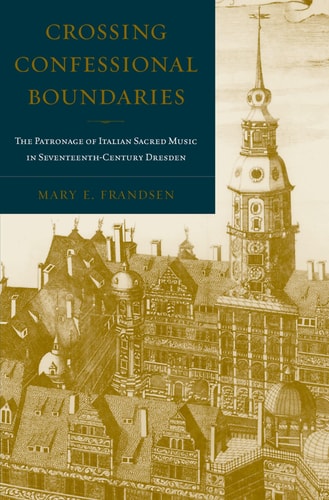
Crossing Confessional Boundaries: The Patronage of Italian Sacred Music in Seventeenth-Century Dresden
0
0
As an Amazon Associate and affiliate partner, Menrva Books earns from qualifying purchases. Learn more
Author Description
Shortly after assuming the Saxon throne in 1656, Lutheran Elector Johann Georg II (r. 1656-80) replaced the elder Kapellmeister Heinrich Schütz with younger Italian Catholic composers. Seemingly overnight, sacred music in the most modern Italian style, first by Vincenzo Albrici (1631-90/96) and later by Giuseppe Peranda (ca. 1625-75) supplanted the more traditional Schützian sacred concerto and Spruchmotette, effecting a change in musical and spiritual life both within the walls of the Dresden court and beyond.Drawing on extensive research in primary source materials, Frandsen explores the elector's "Italianization" of the Hofkapelle with castrati and other Italian virtuosi, and examines the larger confessional conflict that gripped the city of Dresden and its implications for the Catholic-leaning elector's musical agenda. She then examines the Latin texts set by Albrici and Peranda, a body of works dominated by expressions of mystical devotion typical of the repertoire then heard in Italy. However, drawing upon recent studies of the phenomenon of "new piety" in seventeenth-century Lutheranism, Frandsen locates these texts squarely within the realm of contemporary Lutheran spirituality, and demonstrates their congruity with devotional materials used by Lutherans since the mid-sixteenth century. In her discussion of the sacred concertos of Albrici and Peranda, she takes the concept of musica pathetica as a point of departure, and also explores the formal and stylistic relationships between the Roman motet and the new sacred concerto in Dresden. Finally, with the help of liturgies recorded in court diaries, she reintegrates this music into its original performance environment, and demonstrates how tightly the works of these Italians were woven into the Gospel-determined thematic fabric of the services celebrated during the church year.A fascinating account of the uneasy alliance of two confessions at the prominent seventeenth-century court of Dresden, this book provides a new perspective on the cultural history of the period.
Menrva's Summary
THE THESIS
This book investigates how the patronage of Italian Catholic composers by the Lutheran Elector Johann Georg II transformed the musical and spiritual landscape of the seventeenth-century Dresden court. Mary E. Frandsen, a scholar of music history, utilizes extensive primary source research, including court diaries and liturgical records, to challenge the assumption that the adoption of Italian musical styles represented a departure from Lutheran orthodoxy. She argues that these works were integrated into a specific Lutheran devotional framework, bridging the gap between confessional identities through the shared language of mystical piety.
THE SCOPE MAP
What You Will Find
- Analysis of the transition from Schützian sacred concertos to the modern Italian style under composers Vincenzo Albrici and Giuseppe Peranda.
- Examination of the 'new piety' movement within seventeenth-century Lutheranism and its influence on musical text selection.
- Investigation of the concept of musica pathetica and its formal application in the Roman motet and the Dresden sacred concerto.
- Reconstruction of the performance environment using court diaries to link musical works to specific liturgical services.
THE AUTHORITY PERSPECTIVE
Scholars recognize this work as a significant contribution to the study of early modern court culture and the intersection of music and theology. Readers frequently note the academic density of the prose, which provides a rigorous examination of both musical scores and historical confessional politics.
Page Count:
530
Publication Date:
2011-12-01
Publisher:
Oxford University Press
ISBN-10:
0199862494
ISBN-13:
9780199862498
European History
Humanities
Musicology
Seventeenth Century
Church music
Music History
Religious History
Community Tags
Similar Books










Reader Comments
Share Your Thoughts
No comments yet. Be the first to share your thoughts!