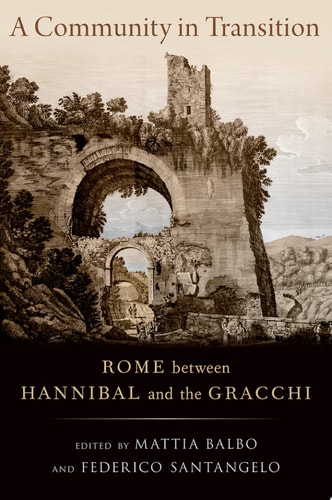
A Community in Transition: Rome between Hannibal and the Gracchi
0
0
As an Amazon Associate and affiliate partner, Menrva Books earns from qualifying purchases. Learn more
Author Description
This volume gathers twelve studies on key aspects of the history of Rome and its empire between the end of the Hannibalic War (200 BCE) and the election of Tiberius Gracchus to the tribunate (134 BCE). Through this periodization, which places the focus on what intervened between two major and well-studied historical turning points in Republican history, the book aims to bring new light to the interplay between imperial expansion, political volatility, and intellectual developments, and on the various levels on which historical change unfolded.The lack of a continuous ancient narrative for this period, even late or derivative, has shaped much of the historiographical discourse about it. This volume seeks to convey a new sense of the depth of the period and establishes new connections among aspects of human agency and action that are usually considered in isolation from one another. It puts in fruitful dialogue contribution on a range of topics as diverse as climate change, oratory, agrarian laws, urban architecture, and the civilian military, among others. The result is a diverse, multifocal, non-hierarchical assessment of a critical but often understudied period in Roman history.With a well-balanced list of established and up-and-coming scholars, A Community in Transition fills a substantial historiographical gap in the study of the Roman Republic.
Menrva's Summary
THE THESIS
This volume investigates the transformative socio-political and intellectual developments within the Roman Republic during the critical interval between the end of the Hannibalic War and the rise of Tiberius Gracchus. Editors Federico Santangelo and Mattia Balbo curate a collection of twelve scholarly studies that address the historiographical void left by the absence of a continuous ancient narrative for this era. By synthesizing diverse research perspectives, the authors argue that this period was not merely a static interlude but a dynamic phase of significant structural and cultural evolution.
THE SCOPE MAP
What You Will Find
- Analysis of the interplay between Roman imperial expansion and internal political volatility.
- Examination of diverse thematic areas including agrarian legislation, urban architecture, and oratory.
- Integration of environmental factors such as climate change alongside traditional military and civilian history.
- A multi-focal methodology that connects human agency with broader institutional change.
THE AUTHORITY PERSPECTIVE
Experts identify this collection as a vital contribution to Roman Republican studies, specifically for its focus on a neglected chronological gap. Scholars frequently note the academic rigor of the contributions and the effectiveness of the volume in bridging disparate sub-disciplines of classical history.
Page Count:
392
Publication Date:
2022-12-01
Publisher:
Oxford University Press
ISBN-10:
0197655246
ISBN-13:
9780197655245
History
Roman History
Italy history
Ancient History
Political History
Community Tags
Similar Books














