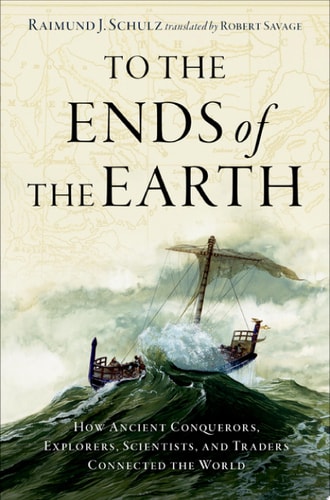
To the Ends of the Earth: How Ancient Explorers, Scientists, and Traders Connected the World
0
0
As an Amazon Associate and affiliate partner, Menrva Books earns from qualifying purchases. Learn more
Author Description
A sweeping history of ancient exploration, the first full-scale account in over a centuryOdysseus. Jason and the Argonauts. Heracles. Greek mythology is full of tales of heroes setting out for the unknown. Such tales reflected and instilled a sense of confidence in the Greeks as they explored the limits of their world. Their voyages of discovery (and conquest), most dramatically under Alexander the Great, are but the most famous examples of ancient exploration. These expeditions were built on earlier voyages, notably those by Bronze Age Egyptians and Mesopotamians, and led to further global travel, trade, and warfare among the Romans, Persians, Scythians, Indians, and Chinese.To the Ends of the Earth is the first modern history of ancient exploration in over a century. Ranging from the Mediterranean Bronze Age to the third century CE, it reveals long-distance, explorative campaigning to be more than a mere ephemeral phenomenon of ancient history. Rather, exploration was, and still is, an integral and driving force of economic, political, and cultural development. Through the prisms of trade, travel, and politics, Raimund J. Schulz provides a sweeping, 1000-year history of all of Eurasia. He traces the pathways and periods of ancient discovery--from the North Atlantic to China, from the Russian steppes to the Sahara--understanding these journeys not as isolated actions, but within their political, military, economic, and cultural contexts. This book explains why adventurers, traders, colonisers, generals, and envoys set out over and over to explore new horizons, the intentions that guided them, and the long-term consequences of their discoveries. By the third century CE remote civilizations were connected as never before and the foundational dynamics of these voyages later contributed to European overseas exploration in the Early Modern Age. To the Ends of the Earth not only offers a fresh look at the ancient world, but also significantly contributes to an understand
Menrva's Summary
THE THESIS
This work investigates how ancient exploration functioned as a primary driver of economic, political, and cultural integration across Eurasia from the Bronze Age to the third century CE. Raimund J. Schulz, a scholar of ancient history, synthesizes archaeological evidence and historical records to argue that long-distance travel was not an isolated phenomenon but a systemic force. By examining the motivations of traders, soldiers, and envoys, the author constructs a framework that links early Mediterranean voyages to the eventual global connectivity of the Early Modern Age.
THE SCOPE MAP
What You Will Find
- A 1000-year historical analysis spanning from the Mediterranean Bronze Age to the third century CE.
- Examination of diverse geographical regions including the North Atlantic, China, the Russian steppes, and the Sahara.
- Analysis of the political, military, and economic motivations behind ancient expeditions.
- Documentation of the interconnectedness between civilizations such as the Egyptians, Persians, Scythians, Indians, and Chinese.
THE AUTHORITY PERSPECTIVE
Scholars and readers recognize this text as a significant modern update to the study of ancient exploration, filling a gap in the literature that has persisted for over a century. The prose is noted for its academic rigor and its ability to synthesize complex historical data into a coherent narrative of global development.
Page Count:
560
Publication Date:
2024-01-01
Publisher:
Oxford University Press
ISBN-10:
019766802X
ISBN-13:
9780197668023
Politics
History
Travel
Archaeology
Exploration
World history
Geography
Ancient History
Community Tags
Similar Books

Reader Comments
Share Your Thoughts
No comments yet. Be the first to share your thoughts!