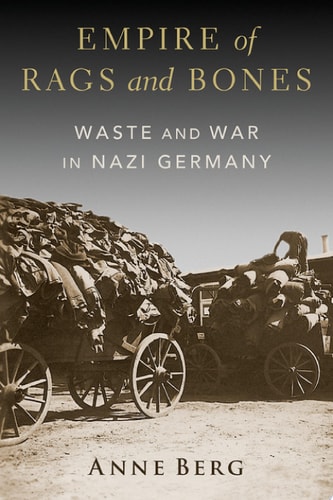
Empire of Rags and Bones: Waste and War in Nazi Germany
0
0
As an Amazon Associate and affiliate partner, Menrva Books earns from qualifying purchases. Learn more
Author Description
Paper, bottles, metal scrap, kitchen garbage, rubber, hair, fat, rags, and bones--the Nazi empire demanded its population obsessively collect anything that could be reused or recycled. Entrepreneurs, policy makers, and ordinary citizens conjured up countless schemes to squeeze value from waste or invent new purposes for defunct or spent material, no matter the cost to people or the environment. As World War II dragged on, rescued loot--much of it waste--clogged transport routes and piled up in warehouses across Europe.Historicizing the much-championed ideal of zero waste, Anne Berg shows that the management of waste was central to the politics of war and to the genesis of genocide in the Nazi Germany. Destruction and recycling were part of an overarching strategy to redress raw material shortages, procure lebensraum, and cleanse the continent of Jews and others considered undesirable. Fostering cooperation between the administration, the party, the German Army, the SS, and industry, resource extending schemes obscured the crucial political role played by virtually all German citizens to whom salvaging, scrapping, and recycling were promoted as inherently virtuous and orderly behaviors. Throughout Nazi occupied-Europe, Jews, POWs, concentration camp inmates, and enemy civilians were forced to recycle the loot, discards, and debris of the Nazi race war. In the end, the materials that were fully exploited and the people who had been bled dry were cast aside, buried, burned, or left to rot. Nonetheless, waste reclamation did not have the power to win the war.Illuminating how the Nazis inverted the economy of value, rescuing discards and murdering people, Empire of Rags and Bones offers an original perspective on genocide, racial ideology, and World War II.
Menrva's Summary
THE THESIS
This work investigates how the Nazi regime integrated waste management and resource recycling into its broader strategies of total war and systematic genocide. Anne Berg, a historian specializing in modern German history, utilizes archival records and administrative documents to demonstrate that the obsession with salvaging materials was not merely an economic necessity but a core component of racial ideology. The book argues that the state-sponsored recycling apparatus facilitated the exploitation of forced labor and obscured the complicity of ordinary citizens in the machinery of mass murder.
THE SCOPE MAP
What You Will Find
- Analysis of the Nazi state's resource-extending schemes and raw material shortages during World War II.
- Examination of the intersection between industrial recycling and the Holocaust.
- Documentation of the forced labor of concentration camp inmates, POWs, and civilians in processing war loot and debris.
- Exploration of the ideological framing of recycling as a virtuous and orderly behavior for the German population.
THE AUTHORITY PERSPECTIVE
Historians and scholars of the Third Reich identify this text as a significant contribution to the study of Nazi economic and racial policies. Readers frequently note the meticulous research and the chilling clarity with which Berg connects mundane domestic recycling to the logistics of genocide.
Page Count:
368
Publication Date:
2024-01-01
Publisher:
Oxford University Press
ISBN-10:
0197744001
ISBN-13:
9780197744000
History
Economic History
Nazi Germany
Environmental History
Community Tags
Similar Books