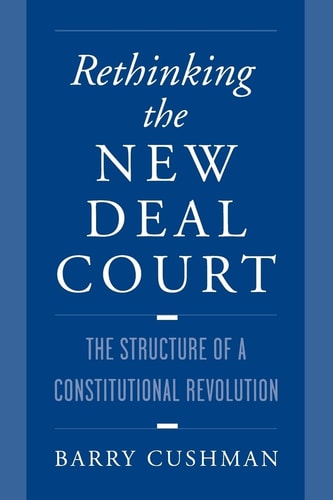
Rethinking the New Deal Court: The Structure of a Constitutional Revolution
0
0
As an Amazon Associate and affiliate partner, Menrva Books earns from qualifying purchases. Learn more
Author Description
This book challenges the prevailing account of the Supreme Court of the New Deal era, which holds that in the spring of 1937 the Court suddenly abandoned jurisprudential positions it had staked out in such areas as substantive due process and commerce clause doctrine. In the conventional view, the impetus for such a dramatic reversal was provided by external political pressures manifested in FDR's landslide victory in the 1936 election, and by the subsequent Court-packing crisis. Author Barry Cushman, by contrast, discounts the role that political pressure played in securing this "constitutional revolution." Instead, he reorients study of the New Deal Court by focusing attention on the internal dynamics of doctrinal development and the role of New Dealers in seizing opportunities presented by doctrinal change.Recasting this central story in American constitutional development as a chapter in the history of ideas rather than simply an episode in the history of politics, Cushman offers a thoroughly researched and carefully argued study that recharacterizes the mechanics by which laissez-faire constitutionalism unraveled and finally collapsed during FDR's reign. Identifying previously unseen connections between several different lines of doctrine, Rethinking the New Deal Court charts the manner in which Nebbia v. New York's abandonment of the distinction between public and private enterprise hastened the demise of the doctrinal structure in which that distinction had played a central role. As intelligent as it is revisionist, this volume will greatly interest students of legal history, constitutional law, and political science.
Menrva's Summary
THE THESIS
Does the conventional narrative of the 1937 Supreme Court shift accurately reflect the internal mechanics of constitutional change, or is it an oversimplification of political pressure? Barry Cushman, a professor of law and history, utilizes extensive archival research and doctrinal analysis to challenge the prevailing view that the New Deal Court's reversal was primarily a reaction to FDR's Court-packing threat. He argues instead that the collapse of laissez-faire constitutionalism was an internal evolution of legal doctrine, specifically driven by the erosion of the public-private enterprise distinction initiated in cases like Nebbia v. New York.
THE SCOPE MAP
What You Will Find
- Analysis of substantive due process and commerce clause jurisprudence during the 1930s.
- Examination of the internal doctrinal shifts leading to the collapse of laissez-faire constitutionalism.
- Detailed case studies of pivotal Supreme Court decisions including Nebbia v. New York.
- A re-evaluation of the influence of political pressure versus intellectual development in legal history.
THE AUTHORITY PERSPECTIVE
Legal scholars and historians frequently cite this work as a significant revisionist text that forces a re-examination of standard constitutional history narratives. Readers often note the high level of academic density and the meticulous nature of the author's doctrinal research.
Page Count:
336
Publication Date:
1998-02-26
Publisher:
Oxford University Press
ISBN-10:
0195120434
ISBN-13:
9780195120431
History
United States
Law
Constitutional Law
American History
Professional Career & Trade
American Government