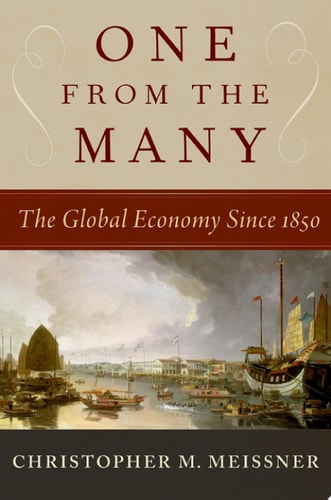
One From the Many: The Global Economy Since 1850
0
0
As an Amazon Associate and affiliate partner, Menrva Books earns from qualifying purchases. Learn more
Author Description
Amid a recent surge in arguments that the global economy has begun to "de-globalize," a question has emerged: will globalization survive? In One from the Many: The Global Economy since 1850, Christopher M. Meissner argues that based on the long-run of history, globalization will not be easily vanquished.This brief introduction to the economic history of the global economy and the process of globalization since 1850 tracks and explains changes in international trade, migration, and capital flows over time. All key indicators of globalization rose between 1850 and 1914 during the first wave of globalization. Between 1918 and 1939 the global economy stagnated, suffering a momentous collapse during the Great Depression of the 1930s. After World War II, the global economy re-emerged and integration deepened.A long-run view suggests that rising integration and growth of global economy can generate economic benefits and raise welfare. Given these lessons, the global economy will almost surely survive and integration will continue to grow. However, globalization can only survive if humanity continues to recognize its common interests and the untapped potential of further integration. At the same time, the potential adverse effects of greater integration must be acknowledged, mitigated, and minimized. Meissner's brief history of the global economy offers economics, political science, and history students a new perspective on the history of its subject matter, with an eye on a future where globalization has the potential to persist as an integrative force.
Menrva's Summary
THE THESIS
Will the global economy survive the current trend of de-globalization, or is the historical trajectory of integration too robust to be reversed? Christopher M. Meissner, a scholar of economic history, utilizes long-run data from 1850 to the present to evaluate the resilience of international trade, migration, and capital flows. He argues that historical evidence demonstrates a persistent capacity for integration, suggesting that while globalization faces significant challenges, its structural benefits ensure its survival provided that common interests are recognized and adverse effects are actively mitigated.
THE SCOPE MAP
What You Will Find
- Analysis of key economic indicators including international trade, migration patterns, and capital flows since 1850.
- A comparative historical framework covering the first wave of globalization (1850-1914), the interwar stagnation (1918-1939), and the post-WWII era of integration.
- Evaluation of the economic benefits and welfare improvements associated with global market integration.
- Policy-oriented discussion on the necessity of mitigating the adverse effects of globalization to ensure its continued viability.
THE AUTHORITY PERSPECTIVE
Experts identify this work as a concise and accessible primer for students of economics and political science seeking a historical context for modern trade debates. Readers frequently note the clarity with which Meissner synthesizes complex economic data into a coherent long-term narrative.
Page Count:
352
Publication Date:
2024-01-01
Publisher:
Oxford University Press
ISBN-10:
0197759319
ISBN-13:
9780197759318
History
Economics
Economic History
Globalization
International Trade
Community Tags
Similar Books