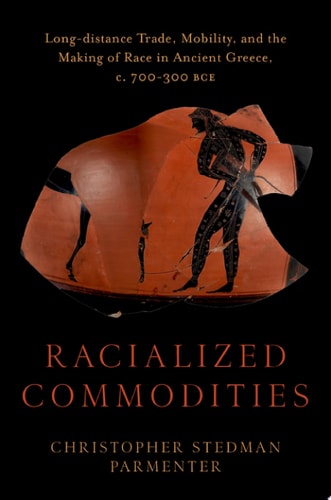
Racialized Commodities: Long-distance Trade, Mobility, and the Making of Race in Ancient Greece, c. 700-300 BCE
0
0
As an Amazon Associate and affiliate partner, Menrva Books earns from qualifying purchases. Learn more
Author Description
Between c. 700-300 BCE, the ancient Greeks developed a vivid imaginary of the world's peoples. Ranging from the light-skinned, "gray-eyed Thracians" of the distant north to the "dark-skinned Ethiopians" of the far south, as the poet Xenophanes described them around 540 BCE, Greeks envisioned a world populated by human groups with distinct physiognomies. Racialized Commodities traces how Greece's "racial imaginary"--a confluence of thinking about cultural geography, commodity production, and human physiognomy--emerged from cross-cultural trade between Greece and its Mediterranean neighbors during the Archaic and Classical Periods. It adopts the model of a "commodity biography" to investigate how trade led to the entanglement of cultures, bodies, and things in Archaic and Classical Greece. For merchants, the racial imaginary might be used to play up the "exotic" provenance of their goods to consumers. It might also circulate practical information about customs, pricing, navigation, and doing business in foreign ports.Archaic Greek attempts to explain foreign bodies were rarely pejorative, and Racialized Commodities begins with some of their earliest images of African peoples, described by Greeks as Egyptians or Ethiopians, before seeking to explain what changed in the early Classical Period. As the Persian Empire loomed and Greek cities became increasingly dependent on enslaved labor, negative stereotypes of Thracians and Scythians became widespread and coalesced into the charged idea of the barbarous--the "barbarian."
Menrva's Summary
THE THESIS
This work investigates how the intersection of long-distance trade, commodity production, and cultural geography fostered the development of a racial imaginary in ancient Greece between 700 and 300 BCE. Christopher Stedman Parmenter utilizes the framework of commodity biography to analyze how the movement of goods across the Mediterranean influenced Greek perceptions of human physiognomy and foreign identity. By examining the transition from early, non-pejorative descriptions of diverse peoples to the later emergence of the barbarian stereotype, the author argues that economic entanglement played a central role in shaping social hierarchies and racialized thinking in the Archaic and Classical periods.
THE SCOPE MAP
What You Will Find
- An analysis of the Archaic and Classical periods in Greece, specifically spanning 700 to 300 BCE.
- The application of the commodity biography methodology to trace the relationship between trade goods and human perception.
- An examination of primary source texts, including the works of Xenophanes and other contemporary observers.
- A detailed study of how the rise of the Persian Empire and the expansion of enslaved labor systems influenced the construction of the barbarian identity.
THE AUTHORITY PERSPECTIVE
Scholars in the field of classical history recognize this text as a rigorous examination of the intersection between economic history and social identity. Readers frequently note the academic density of the prose and the author's precise use of material culture to support his historical arguments.
Page Count:
400
Publication Date:
2024-08-23
Publisher:
Oxford University Press
ISBN-10:
0197757111
ISBN-13:
9780197757116
History
Politics
Economics
Sociology
Ancient History
Community Tags
Similar Books