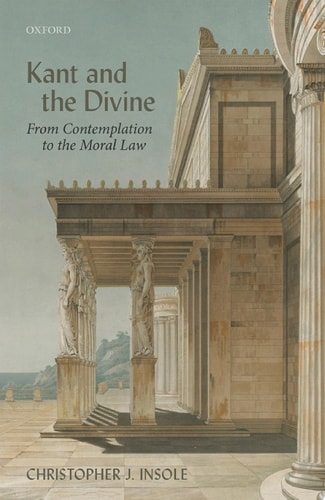
Kant and the Divine: From Contemplation to the Moral Law
0
0
As an Amazon Associate and affiliate partner, Menrva Books earns from qualifying purchases. Learn more
Author Description
The book offers a definitive study of the development of Kant's conception of the highest good, from his earliest work, to his dying days. Insole argues that Kant believes in God, but that Kant is not a Christian, and that this opens up an important and neglected dimension of Western Philosophy. Kant is not a Christian, because he cannot accept Christianity's traditional claims about the relationship between divine action, grace, human freedom and happiness. Christian theologians who continue to affirm these traditional claims (and many do), therefore have grounds to be suspicious of Kant as an interpreter of Christian doctrine. As well as setting out a theological critique of Kant, Insole offers a new defence of the power, beauty, and internal coherence of Kant's non-Christian philosophical religiosity, 'within the limits of reason alone', which reason itself has some divine features. This neglected strand of philosophical religiosity deserves to be engaged with by both philosophers, and theologians. The Kant revealed in this book reminds us of a perennial task of philosophy, going back to Plato, where philosophy is construed as a way of life, oriented towards happiness, achieved through a properly expansive conception of reason and happiness. When we understand this philosophical religiosity, many standard 'problems' in the interpretation of Kant can be seen in a new light, and resolved. Kant witnesses to a strand of philosophy that leans into the category of the divine, at the edges of what we can say about reason, freedom, autonomy, and happiness.
Menrva's Summary
THE THESIS
Does Immanuel Kant’s philosophical system necessitate a belief in God, and if so, how does this conception of the divine diverge from traditional Christian doctrine? Christopher J. Insole provides a comprehensive analysis of Kant’s evolving thought regarding the 'highest good' from his early writings to his final works. The author argues that while Kant maintains a commitment to a form of divine presence, he rejects core Christian tenets concerning grace and divine intervention. Insole posits that Kant’s unique 'philosophical religiosity' offers a coherent, reason-based framework that reorients the human pursuit of happiness and autonomy.
THE SCOPE MAP
What You Will Find
- A chronological examination of Kant’s development of the highest good.
- A critical comparison between Kantian ethics and traditional Christian theology.
- An exploration of the intersection between human reason and divine attributes.
Scope Limits
- The text does not provide a general introduction to Kant’s entire body of work.
- It does not attempt to reconcile Kant with all branches of contemporary Christian thought.
THE AUTHORITY PERSPECTIVE
Scholars recognize this work as a significant contribution to the intersection of Kantian studies and theology, often noting the rigor of Insole’s philosophical argumentation. Readers frequently highlight the text's ability to clarify long-standing interpretive debates regarding Kant’s religious commitments.
Page Count:
425
Publication Date:
2020-01-01
Publisher:
OUP Oxford
ISBN-10:
0192594958
ISBN-13:
9780192594952
Philosophy
Religion
Theology
Ethics
Metaphysics
Community Tags
Similar Books