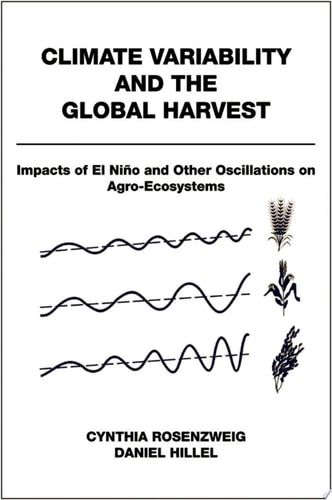
Climate Variability and the Global Harvest: Impacts of El Niño and Other Oscillations on Agro-Ecosystems
0
0
As an Amazon Associate and affiliate partner, Menrva Books earns from qualifying purchases. Learn more
Author Description
The Earth's climate is constantly changing. Some of the changes are progressive, while others fluctuate at various time scales. The El Nino-la Nina cycle is one such fluctuation that recurs every few years and has far-reaching impacts. It generally appears at least once per decade, but this may vary with our changing climate. The exact frequency, sequence, duration and intensity of El Nino's manifestations, as well as its effects and geographic distributions, are highly variable. The El Nino-la Nina cycle is particularly challenging to study due to its many interlinked phenomena that occur in various locations around the globe. These worldwide teleconnections are precisely what makes studying El Nino-la Nina so important. Cynthia Rosenzweig and Daniel Hillel describe the current efforts to develop and apply a global-to-regional approach to climate-risk management. They explain how atmospheric and social scientists are cooperating with agricultural practitioners in various regions around the world to determine how farmers may benefit most from new climate predictions. Specifically, the emerging ability to predict the El Nino-Southern Oscillation (ENSO) cycle offers the potential to transform agricultural planning worldwide. Biophysical scientists are only now beginning to recognize the large-scale, globally distributed impacts of ENSO on the probabilities of seasonal precipitation and temperature regimes. Meanwhile, social scientists have been researching how to disseminate forecasts more effectively within rural communities. Consequently, as the quality of climatic predictions have improved, the dissemination and presentation of forecasts have become more effective as well. This book explores the growing understanding of the interconnectedness of climate predictions and productive agriculture for sustainable development, as well as methods and models used to study this relationship.
Menrva's Summary
THE THESIS
This book investigates the complex relationship between the El Niño-Southern Oscillation (ENSO) cycle and global agricultural productivity, questioning how climate forecasting can be integrated into sustainable farming practices. Authors Cynthia Rosenzweig and Daniel Hillel, both established experts in climate and agricultural science, synthesize data from atmospheric, social, and biophysical research. They argue that by bridging the gap between predictive climate modeling and practical agricultural application, stakeholders can better manage climate-related risks. The text provides a framework for understanding how global teleconnections influence regional precipitation and temperature, ultimately impacting food security.
THE SCOPE MAP
What You Will Find
- Analysis of the El Niño-Southern Oscillation (ENSO) cycle and its global teleconnections.
- Methodologies for integrating climate predictions into regional agricultural planning.
- Case studies on the collaboration between atmospheric scientists, social scientists, and agricultural practitioners.
- Evaluation of models used to assess the impact of climate variability on agro-ecosystems.
THE AUTHORITY PERSPECTIVE
Experts recognize this work as a foundational text for understanding the intersection of climate science and food production. Readers frequently note the technical density of the prose, which serves as a comprehensive resource for researchers and policy makers in the field of sustainable development.
Page Count:
280
Publication Date:
2008-01-01
Publisher:
Oxford University Press
ISBN-10:
0198031475
ISBN-13:
9780198031475
Science
Categories
Climatology
Kindle eBooks
Sustainability
Agriculture
Kindle Store
Community Tags
Other Editions(2)
Similar Books
Reader Comments
Share Your Thoughts
No comments yet. Be the first to share your thoughts!