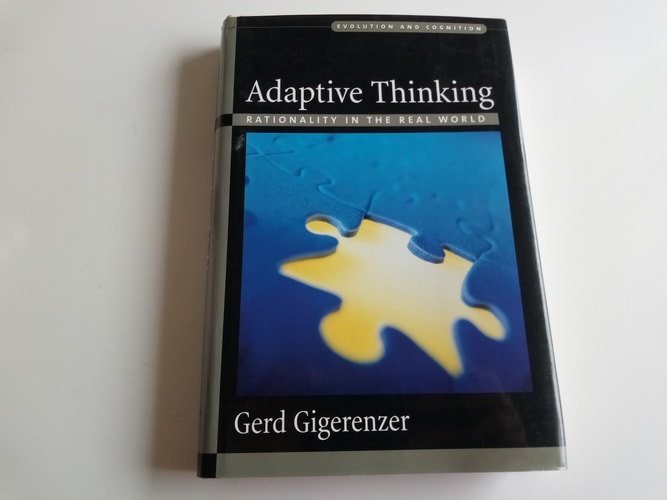
Adaptive Thinking: Rationality in the Real World
0
0
As an Amazon Associate and affiliate partner, Menrva Books earns from qualifying purchases. Learn more
Author Description
Where do new ideas come from? What is social intelligence? Why do social scientists perform mindless statistical rituals? This vital book is about rethinking rationality as adaptive thinking: to understand how minds cope with their environments, both ecological and social. Gerd Gigerenzer proposes and illustrates a bold new research program that investigates the psychology of rationality, introducing the concepts of ecological, bounded, and social rationality. His path-breaking collection takes research on thinking, social intelligence, creativity, and decision-making out of an ethereal world where the laws of logic and probability reign, and places it into our real world of human behavior and interaction. Adaptive Thinking is accessibly written for general readers with an interest in psychology, cognitive science, economics, sociology, philosophy, artificial intelligence, and animal behavior. It also teaches a practical audience, such as physicians, AIDS counselors, and experts in criminal law, how to understand and communicate uncertainties and risks.
Menrva's Summary
THE THESIS
This book investigates how human rationality functions as an adaptive mechanism within complex, uncertain environments rather than as a rigid adherence to formal logic. Gerd Gigerenzer, a prominent psychologist and director at the Max Planck Institute, challenges the traditional view of rationality as a purely mathematical or logical process. By drawing on evolutionary biology and cognitive psychology, he argues that human decision-making is best understood through the lens of ecological and bounded rationality. The work provides a framework for evaluating how heuristics—simple rules of thumb—often outperform complex statistical models in real-world scenarios.
THE SCOPE MAP
What You Will Find
- Analysis of ecological, bounded, and social rationality frameworks.
- Critique of traditional statistical rituals in social science research.
- Practical applications for risk communication in medicine, law, and counseling.
- Exploration of the intersection between human behavior, artificial intelligence, and animal cognition.
THE AUTHORITY PERSPECTIVE
Experts recognize this work as a foundational text for understanding the shift from normative logic to descriptive, adaptive decision-making models. Readers frequently note the clarity of the prose, which makes complex cognitive science accessible to both academics and practitioners in fields like medicine and law.
Page Count:
360
Publication Date:
2002-01-01
Publisher:
Oxford University Press
ISBN-10:
0198031173
ISBN-13:
9780198031178
Economics
Psychology
Philosophy
Decision Making
Thought And Thinking
Sociology
Cognition
Logic & Critical Reasoning
Professional Career & Trade
Rationalism