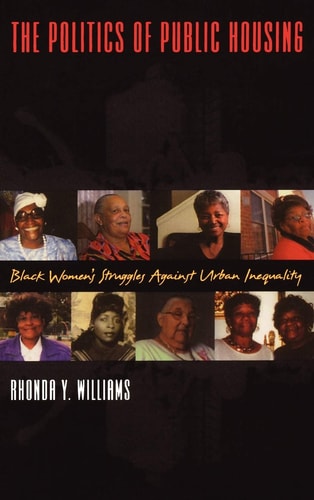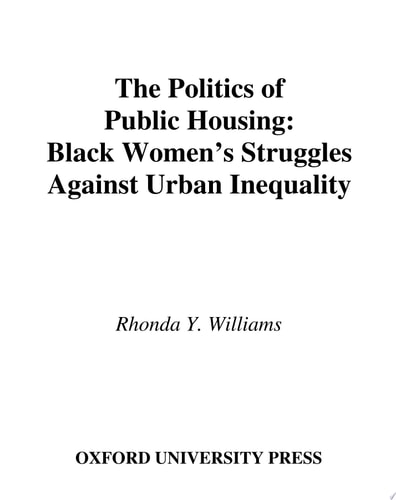
The Politics of Public Housing: Black Women's Struggles against Urban Inequality
0
0
As an Amazon Associate and affiliate partner, Menrva Books earns from qualifying purchases. Learn more
Author Description
Black women have traditionally represented the canvas on which many debates about poverty and welfare have been drawn. For a quarter century after the publication of the notorious Moynihan report, poor black women were tarred with the same brush: "ghetto moms" or "welfare queens" living off the state, with little ambition or hope of an independent future. At the same time, the history of the civil rights movement has all too often succumbed to an idolatry that stresses the centrality of prominent leaders while overlooking those who fought daily for their survival in an often hostile urban landscape. In this collective biography, Rhonda Y. Williams takes us behind, and beyond, politically expedient labels to provide an incisive and intimate portrait of poor black women in urban America. Drawing on dozens of interviews, Williams challenges the notion that low-income housing was a resounding failure that doomed three consecutive generations of post-war Americans to entrenched poverty. Instead, she recovers a history of grass-roots activism, of political awakening, and of class mobility, all facilitated by the creation of affordable public housing. The stereotyping of black women, especially mothers, has obscured a complicated and nuanced reality too often warped by the political agendas of both the left and the right, and has prevented an accurate understanding of the successes and failures of government anti-poverty policy. At long last giving human form to a community of women who have too often been treated as faceless pawns in policy debates, Rhonda Y. Williams offers an unusually balanced and personal account of the urban war on poverty from the perspective of those who fought, and lived, it daily.
Menrva's Summary
THE THESIS
This work investigates how poor Black women in urban America navigated and challenged systemic inequality through the lens of public housing activism. Rhonda Y. Williams, a scholar of African American history, utilizes extensive oral histories and archival research to dismantle the reductive stereotypes of 'welfare queens' that dominated post-war political discourse. By centering the voices of the women who lived in public housing, the author argues that these communities were not merely sites of failure, but active spaces of political engagement, class mobility, and grass-roots resistance against urban marginalization.
THE SCOPE MAP
What You Will Find
- A detailed examination of post-war urban housing policy and its impact on Black communities.
- Primary source interviews providing intimate, first-hand accounts of daily survival and activism.
- A critical analysis of the intersection between gender, race, and government anti-poverty initiatives.
- A historical framework that challenges the Moynihan report and subsequent political narratives regarding welfare.
THE AUTHORITY PERSPECTIVE
Scholars and historians frequently cite this text as a vital corrective to top-down historical accounts of the civil rights era. The book is recognized for its methodological rigor in blending collective biography with structural political analysis, making it a standard reference for those studying urban inequality.
Page Count:
320
Publication Date:
2004-01-01
Publisher:
Oxford University Press
ISBN-10:
0198036035
ISBN-13:
9780198036036
Politics
History
Americas
Reference
Womens Studies
Sociology
Women in History
Urban Studies
Kindle eBooks
Words Language & Grammar
Categories
Ethnic Studies
Linguistics
Kindle Store
Poor housing
Urban
United States