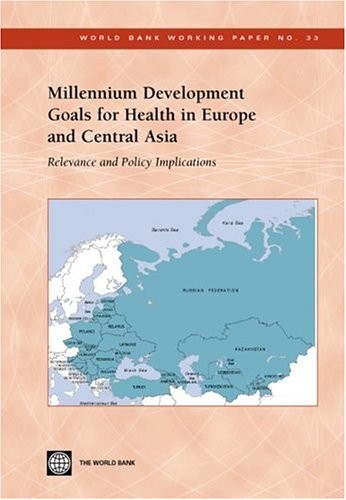
Millennium Development Goals for Health in Europe and Central Asia
0
0
As an Amazon Associate and affiliate partner, Menrva Books earns from qualifying purchases. Learn more
Author Description
This study aims to contribute to the debate about the appropriateness of health-related Millennium Development Goals (MDGs) for the countries of the Europe and Central Asia (ECA) region. The study has important implications for policy choices at the regional, subregional, and country levels. Despite the fact that averages mask variations that exist within countries, certain conclusions stand out: for the ECA region as a whole, proportionately more gains in life expectancy would accrue from the control of non-communicable diseases (NCDs) than from achieving the targets in the classic MDGs. This pattern holds in all subregions; there are proportionately more gains to be had from achieving the classic MDGs in Central Asia and the Caucasus subregions. For priority setting, policy formulations, programs, and development assistance, the key messages from this study are: the importance of reducing morbidity and premature mortality from NCDs and external causes across the entire region; the need for particular attention to the classis MDG indicators (infant mortality rates, under-5 mortality rates, and maternal mortality ratios) in the countries of Central Asia and the Caucasus; the importance of establishing effective and sustainable surveillance, vital registration, and health information systems to provide valid data for local decisions and international comparisons; and the continued need for interagency collaboration in support of all these objectives.--BOOK JACKET.
Menrva's Summary
THE THESIS
This study investigates the relevance and impact of the Millennium Development Goals (MDGs) for health outcomes in the Europe and Central Asia (ECA) region. The research, authored by Bernd Rechel, analyzes the potential gains in life expectancy achievable through controlling non-communicable diseases (NCDs) versus meeting classic MDG targets. It highlights that while NCD control offers greater overall gains for the ECA region, specific subregions like Central Asia and the Caucasus require focused attention on classic MDG indicators such as infant, under-5, and maternal mortality rates. The study emphasizes the critical need for robust health information systems and interagency collaboration to support policy decisions and development assistance.
THE SCOPE MAP
- Analysis of health-related Millennium Development Goals (MDGs) for the Europe and Central Asia (ECA) region.
- Comparison of potential life expectancy gains from controlling non-communicable diseases (NCDs) versus achieving classic MDG targets.
- Subregional analysis of MDG relevance, with specific focus on Central Asia and the Caucasus.
- Implications for policy choices at regional, subregional, and country levels.
- Recommendations for priority setting, program development, and development assistance.
- Emphasis on reducing morbidity and premature mortality from NCDs and external causes.
- Importance of strengthening surveillance, vital registration, and health information systems.
- Call for continued interagency collaboration in health sector development.
THE AUTHORITY PERSPECTIVE
The study provides a detailed analysis of the Millennium Development Goals' applicability to the Europe and Central Asia region, offering specific policy recommendations. It highlights the nuanced approach required, suggesting that while non-communicable diseases present a significant area for health improvement across the region, classic MDG indicators remain crucial for certain subregions. The research underscores the necessity of data infrastructure and collaborative efforts for effective health policy.
Page Count:
56
Publication Date:
2004-01-01
ISBN-10:
0821358782
Politics
Health
Non-Fiction
Health Policy
Europe
International Development
Central Asia
Public Health
Community Tags
Similar Books