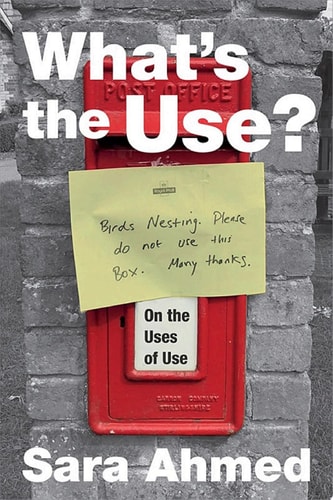
What's the Use? On the Uses of Use
0
0
As an Amazon Associate and affiliate partner, Menrva Books earns from qualifying purchases. Learn more
Author Description
In What's the Use? Sara Ahmed continues the work she began in The Promise of Happiness and Willful Subjects by taking up a single word—in this case, use—and following it around. She shows how use became associated with life and strength in nineteenth-century biological and social thought and considers how utilitarianism offered a set of educational techniques for shaping individuals by directing them toward useful ends. Ahmed also explores how spaces become restricted to some uses and users, with specific reference to universities. She notes, however, the potential for queer use: how things can be used in ways that were not intended or by those for whom they were not intended. Ahmed posits queer use as a way of reanimating the project of diversity work as the ordinary and painstaking task of opening up institutions to those who have historically been excluded.
Menrva's Summary
THE THESIS
This book investigates the multifaceted concept of 'use' and its historical and social implications. Sara Ahmed traces the evolution of 'use' from its association with life and strength in the 19th century to its role in utilitarianism and educational shaping. The analysis extends to how institutional spaces, particularly universities, become restricted in their uses and users, while also highlighting the potential for 'queer use'—employing things in unintended ways or by unintended users. Ahmed ultimately frames queer use as a method for revitalizing diversity work by focusing on the persistent effort to open institutions to historically excluded groups.
THE SCOPE MAP
- Analysis of the historical trajectory of the word 'use' in biological and social thought.
- Exploration of utilitarianism and its techniques for directing individuals toward 'useful' ends.
- Examination of how institutional spaces, specifically universities, become sites of restricted use.
- Introduction and exploration of the concept of 'queer use' as a mode of reappropriation.
- Discussion of queer use as a strategy for reanimating diversity work.
- Focus on the 'ordinary and painstaking task' of institutional inclusion.
- Connection to Ahmed's previous works, 'The Promise of Happiness' and 'Willful Subjects'.
THE AUTHORITY PERSPECTIVE
Sara Ahmed's 'What's the Use?' is recognized for its rigorous theoretical engagement with the concept of 'use' and its implications for social and institutional structures. The book is noted for its critical examination of how 'use' has been historically deployed to define and restrict individuals, particularly within academic settings. Scholars appreciate Ahmed's innovative concept of 'queer use' as a tool for challenging established norms and advocating for greater inclusivity. The work is considered a significant contribution to queer theory and critical university studies, offering a framework for understanding and enacting institutional change.
Page Count:
296
Publication Date:
2019-10-25
Publisher:
Duke University Press
ISBN-10:
1478007214
ISBN-13:
9781478007210
Non-Fiction
Philosophy
Queer Theory
Social Theory
Sociology
Gender Studies
Community Tags
Similar Books