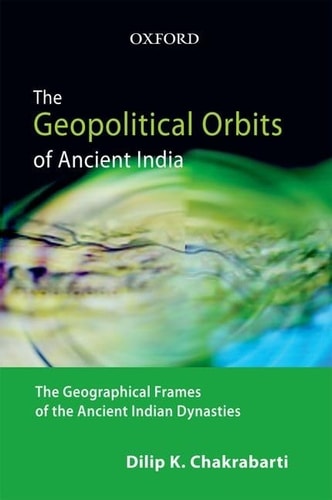
The Geopolitical Orbits of Ancient India: The Geographical Frames of the Ancient Indian Dynasties
0
0
As an Amazon Associate and affiliate partner, Menrva Books earns from qualifying purchases. Learn more
Author Description
This book explores how different parts of the Indian subcontinent interacted throughout its ancient history. Giving a survey of political history in ancient India, it shows that the power politics always revolved around certain defined geo-political orbits. Such orbits form useful concepts to understand the geography of the flow of historical events in India. Using events from history, the book showcases how these orbits formed the focal points around which all ancient Indian dynasties tried to expand their political power and interact with other contemporary dynasties. The author argues that the interaction between these explains why different parts of the subcontinent formed one integrated geo-political whole rather than an agglomeration of many regional units.This book will be of considerable interest to scholars and students of ancient Indian history and archaeology.
Menrva's Summary
THE THESIS
This book investigates the core question of how geographical constraints and defined geopolitical orbits dictated the expansion and interaction of ancient Indian dynasties. Dilip K. Chakrabarti, a noted scholar in Indian archaeology and history, utilizes a survey of political history to argue that these orbits served as the primary framework for regional integration. By analyzing historical events, the author demonstrates that the subcontinent functioned as a cohesive geopolitical entity rather than a collection of isolated regional units.
THE SCOPE MAP
What You Will Find
- A comprehensive survey of political history across the Indian subcontinent.
- The conceptual framework of geopolitical orbits as a tool for historical analysis.
- An examination of how ancient dynasties expanded their power relative to specific geographic focal points.
- Analysis of the integration processes that linked disparate regional units into a single historical whole.
THE AUTHORITY PERSPECTIVE
Scholars and students of ancient Indian history frequently cite this work as a useful conceptual tool for mapping the flow of historical events. Experts highlight the text as a foundational resource for understanding the intersection of geography and political power in the ancient Indian context.
Page Count:
240
Publication Date:
2011-04-01
Publisher:
Oxford University Press
ISBN-10:
0198069898
ISBN-13:
9780198069898
History
India
Archaeology
Geopolitics
Ancient History
Community Tags
Similar Books