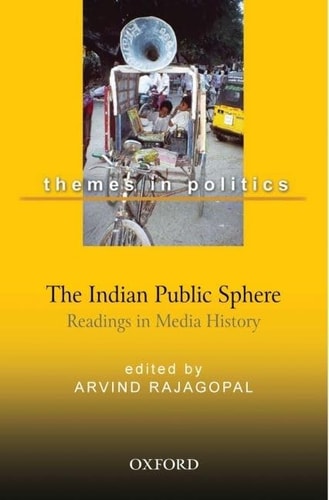
The Indian Public Sphere: Readings in Media History
0
0
As an Amazon Associate and affiliate partner, Menrva Books earns from qualifying purchases. Learn more
Author Description
Part of the Themes in Politics series, this volume examines the emergence of the Indian public sphere and its interplay with politics, society, and culture. It surveys a wide range of communication media contributing to this development--oral, print, radio, television, cinema, and the Internet--through an analysis of the transition from the colonial to the postcolonial period.The essays in this volume show that mediation is a social process that extends beyond 'the media' and must be understood as a component of historical dynamics. They explore a wide range of historical and political mediations--from the use of the drum and buffalo horn as instruments of peasant insurgency against the British, and early Hindi pulp fiction, to socio-political implications of advertising, Hindu tele-epics, saas-bahu serials and the Internet.Identifying the continuities and changes in media from an interdisciplinary perspective, the essays are organized into four themes--the formation of a colonial public sphere; the emergence of a national popular domain; transformations in national developmentalism; and emergent orders such as consumerism and digital culture. A comprehensive introduction provides an understanding of Indian media through the analytical framework of the public sphere.Topical and illuminating, this volume will appeal to students and scholars of Indian politics and governance, media and culture studies, journalism, history, and sociology, as well as the lay reader.
Menrva's Summary
THE THESIS
This volume investigates the historical evolution of the Indian public sphere and its complex, ongoing interplay with political, social, and cultural structures. Arvind Rajagopal, a scholar of media and culture, curates a collection of essays that analyze how mediation functions as a social process rather than merely a technological one. By examining the transition from colonial rule to the postcolonial era, the text provides a framework for understanding how communication media—ranging from traditional oral instruments to digital platforms—have shaped the national consciousness and political landscape of India.
THE SCOPE MAP
What You Will Find
- Historical analysis of media evolution from colonial-era instruments like the buffalo horn to modern digital culture.
- Interdisciplinary framework connecting media studies with political science, sociology, and history.
- Case studies covering Hindi pulp fiction, advertising, Hindu tele-epics, and television serials.
- Thematic organization focusing on the colonial public sphere, national popular domains, and the rise of consumerism.
THE AUTHORITY PERSPECTIVE
Scholars and students of South Asian studies frequently cite this volume as a foundational text for understanding the intersection of media and governance in India. Experts note that the text provides a rigorous analytical framework that is accessible to both academic researchers and informed lay readers interested in the sociology of communication.
Page Count:
360
Publication Date:
2009-11-16
Publisher:
Oxford University Press
ISBN-10:
019806103X
ISBN-13:
9780198061038
History
Media Studies
Sociology
India
Community Tags
Similar Books