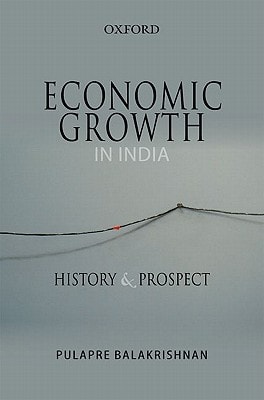
Economic Growth in India: History and Prospect
0
0
As an Amazon Associate and affiliate partner, Menrva Books earns from qualifying purchases. Learn more
Author Description
It is a measure of the youthfulness of economics as a discipline that two centuries after the appearance of Adam Smith's landmark treatise The Wealth of Nations, an economist has posed the question "How do economies grow?" This comprehensive study of economic growth in India is intended as a response to this question. As history, it surveys the half century from the end of colonial rule to the present; as prognosis, it focuses on what we may expect in the immediate future. Drawing upon diverse strands of theory, historical perspective, political economy, and econometrics, the book presents an eclectic and original narrative of the Indian growth experience. The main body of the book is divided into four chapters. Chapter 1 provides a critical exposition of some prominent theoretical representations of growth and a historical perspective on its drivers. The remaining three chapters provide a fresh analysis of three periods, respectively, 1950-64, 1965-91, and 1991 onwards. Presenting a favorable appraisal of the growth record of early independent India and an account of how the advantage was lost, the book argues that it is not just "more reforms" that stand in the way of sustained double-digit growth rates. The prospects for high long-term growth in India are instead linked with development of agriculture and education, particularly schooling. Further, the author proposes that inclusive growth is not just some optional extra, however desirable, but intrinsic to the prosperity of the country. The possibility of such an outcome, he argues, is tied more to the state's capacity to govern the public institutions once created by it than its command over resources.
Menrva's Summary
THE THESIS
This book investigates the fundamental drivers of India's economic growth since independence and evaluates the necessary conditions for sustaining long-term prosperity. Pulapre Balakrishnan, an economist with extensive expertise in macroeconomics and Indian development, utilizes a synthesis of historical data, political economy, and econometric analysis to challenge conventional narratives regarding reform-led growth. He argues that sustained economic success depends less on continuous market liberalization and more on the strategic development of agriculture, education, and the strengthening of public institutions.
THE SCOPE MAP
What You Will Find
- A historical analysis of India's economic performance across three distinct periods: 1950-64, 1965-91, and 1991 to the present.
- A critical evaluation of theoretical growth models applied to the Indian context.
- An examination of the role of state capacity and governance in managing public institutions.
- A policy-oriented argument prioritizing agricultural advancement and schooling as primary catalysts for inclusive growth.
THE AUTHORITY PERSPECTIVE
Economists and scholars of Indian development recognize this work as a rigorous, original contribution to the study of the nation's growth trajectory. Readers frequently note the author's balanced approach in combining historical narrative with technical economic analysis to provide a nuanced perspective on policy outcomes.
Page Count:
352
Publication Date:
2010-09-20
Publisher:
Oxford University Press
ISBN-10:
0198065477
ISBN-13:
9780198065470
Economics
History
Categories
Kindle Store
Kindle eBooks
India
Economic History
Community Tags
Similar Books