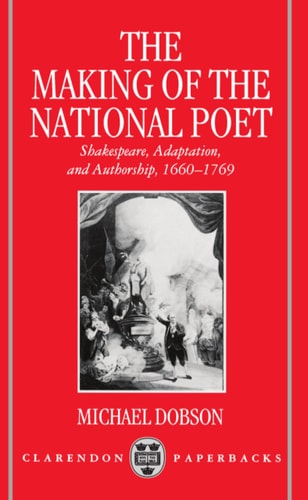
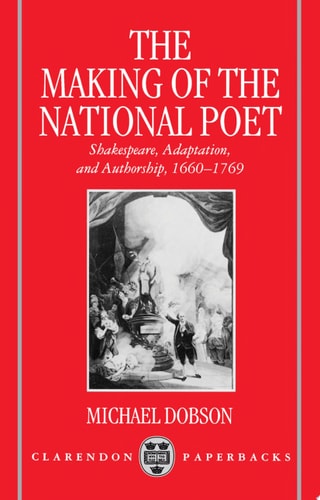
The Making of the National Poet: Shakespeare, Adaptation and Authorship, 1660-1769
0
0
As an Amazon Associate and affiliate partner, Menrva Books earns from qualifying purchases. Learn more
Author Description
The century between the Restoration and David Garrick's Stratford Jubilee saw William Shakespeare's promotion from the status of archaic, rustic playwright to that of England's timeless Bard, and with it the complete transformation of the ways in which his plays were staged, published, and read. But why Shakespeare? and what different interests did this process serve? The Making of the National Poet is the first full-length study since the 1920s of the Restoration and eighteenth century's revisions and revaluations of Shakespeare, and the first to consider the period's much-reviled stage adaptations in the context of the profound cultural changes in which they participate. Drawing on a wide range of evidence--including engravings, promptbooks, diaries, statuary, and previously unpublished poems (among them traces of the hitherto mysterious Shakespeare Ladies' Club), it examines how and why Shakespeare was retrospectively claimed as both a respectable Enlightenment author and a crucial and contested symbol of British national identity. It shows in particular how the deification of Shakespeare co-existed with and even demanded the drastic and sometimes bizarre rewriting of his plays for which the period is notorious. Through engaging and informative analysis, Dobson's book provides the definitive account of the theatre's role in establishing Shakespeare as Britain's National Poet.
Menrva's Summary
THE THESIS
This book investigates the historical mechanisms and cultural motivations behind the transformation of William Shakespeare from a rustic playwright into the singular icon of British national identity between 1660 and 1769. Michael Dobson, a scholar of early modern literature and theatre history, utilizes a diverse array of archival materials to challenge the traditional view of eighteenth-century Shakespearean adaptations as mere corruption. He argues that the deification of the Bard was not a passive process but a deliberate, contested project that required the radical rewriting of plays to align with Enlightenment values and emerging nationalist sentiments.
THE SCOPE MAP
What You Will Find
- Analysis of the Restoration and eighteenth-century theatrical landscape and the specific adaptations of Shakespearean texts.
- Examination of non-textual evidence including engravings, promptbooks, diaries, and statuary.
- Investigation into the influence of the Shakespeare Ladies' Club and other social groups on the canonization process.
- A framework for understanding how Shakespeare was repurposed as a symbol of British national identity and Enlightenment respectability.
THE AUTHORITY PERSPECTIVE
Scholars and historians frequently cite this work as a foundational text for understanding the reception history of Shakespeare in the long eighteenth century. Experts highlight the book's rigorous archival research and its ability to recontextualize previously dismissed stage adaptations as significant cultural artifacts.
Page Count:
280
Publication Date:
1992-12-10
Publisher:
Oxford University Press
ISBN-10:
0198112335
ISBN-13:
9780198112334
History
Great Britain
Literary Criticism
Theatre History
British History
Shakespeare
Community Tags
Other Editions(3)
Similar Books