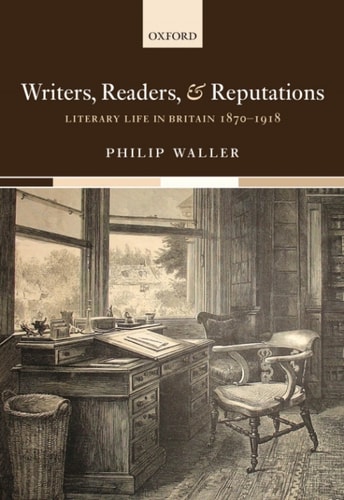
Writers, Readers, and Reputations: Literary Life in Britain 1870-1918
0
0
As an Amazon Associate and affiliate partner, Menrva Books earns from qualifying purchases. Learn more
Author Description
Charles Dickens died in 1870, the same year in which universal elementary education was introduced. During the following generation a mass reading public emerged, and the term 'best-seller' was coined. In new and cheap editions Dickens's stories sold hugely, but these were progressively outstripped in quantity by the likes of Hall Caine and Marie Corelli, Charles Garvice and Nat Gould. Who has now heard of these writers? Yet Hall Caine, for one, boasted of having made more money from his pen than any previous author. This book presents a panoramic view of literary life in Britain over half a century from 1870 to 1918, teasing out authors' relations with the reading public and tracing how reputations were made and unmade. It surveys readers' habits, the book trade, popular literary magazines and the role of reviewers, and examines the construction of a classical canon by critics concerned about the supposed corruption of popular taste. Certain writers were elevated as national heroes, yet Britain drew its writers from abroad as well as from home. Authors became stars and celebrities, and a literary tourism grew around their haunts. They advertised products from cigarettes to toothpaste; they were fashion-conscious and promoted themsevles via profiles, interviews, and carefully posed photographs; they went on lecture tours to America; and their names were pushed by a new professional breed: the literary agent. Some angled for knighthoods, even peerages, and cut a figure in high society and London clubland. They debated public issues of the day and campaigned on all manner of things from questions of faith and women's rights to censorship and conscription. During the Great War they penned propaganda. Meanwhile the cinema was developing to challenge the supremacy of the written word over the imagination. Authors took to that too, as an opportunity for new adventure. Writers, Readers, and Reputations is richly entertaining and informative, amounting to a collective biography of the literary profession in a period of rapid change.
Menrva's Summary
THE THESIS
This work investigates the transformation of the British literary landscape between 1870 and 1918, specifically examining how the emergence of a mass reading public and new commercial pressures redefined the status and influence of authors. Philip J. Waller, a historian of modern Britain, utilizes extensive archival research and contemporary trade records to analyze the shift from traditional literary prestige to the rise of the celebrity author. He argues that the interplay between market forces, educational reform, and the professionalization of the book trade fundamentally altered the relationship between writers and their audiences.
THE SCOPE MAP
What You Will Find
- Analysis of the transition from Victorian literary standards to the commercialized era of the best-seller.
- Examination of the roles played by literary agents, reviewers, and popular magazines in shaping public taste.
- Documentation of the intersection between literature and broader societal shifts, including women's rights, faith, and the propaganda efforts of the Great War.
Scope Limits
- The study focuses primarily on the British market and does not provide an exhaustive global history of publishing during this period.
- It does not offer a comprehensive biography of every author mentioned, but rather uses them as case studies for broader cultural trends.
THE AUTHORITY PERSPECTIVE
Scholars and historians frequently cite this work as a definitive account of the late Victorian and Edwardian literary marketplace. Readers often note the impressive density of the research and the author's ability to synthesize complex social history into a coherent narrative.
Page Count:
1194
Publication Date:
2006-01-01
Publisher:
OUP Oxford
ISBN-10:
0191518697
ISBN-13:
9780191518690
History
Sociology of Literature
Great Britain
Literary Criticism
Publishing History
European History
British History
Community Tags
Similar Books