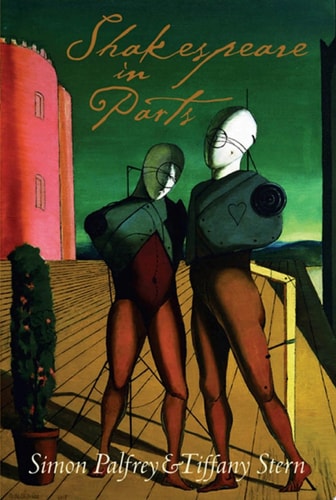
Shakespeare in Parts
0
0
As an Amazon Associate and affiliate partner, Menrva Books earns from qualifying purchases. Learn more
Author Description
A truly groundbreaking collaboration of original theatre history with exciting literary criticism, Shakespeare in Parts is the first book fully to explore the original form in which Shakespeare's drama overwhelmingly circulated. This was not the full play-text; it was not the public performance. It was the actor's part, consisting of the bare cues and speeches of each individual role. With group rehearsals rare or non-existent, the cued part alone had to furnish the actor with his character. But each such part-text was riddled with gaps and uncertainties. The actor knew what he was going to say, but not necessarily when, or why, or to whom; he may have known next to nothing of any other part. It demanded the most sensitive attention to the opportunities inscribed in the script, and to the ongoing dramatic moment. Here is where the young actor Shakespeare learnt his trade; here is where his imagination, verbal and technical, learnt to roam. This is the story of Shakespeare in Parts. As Shakespeare developed his playwriting, the apparent limitations of the medium get transformed into expressive opportunities. Both cue and speech become promise-crammed repositories of meaning and movement, and of individually discoverable space and time. Writing always for the same core group of players, Shakespeare could take - and insist upon - unprecedented risks. The result is onstage drama of astonishing immediacy. Starting with a comprehensive history of the part in early modern theatre, Simon Palfrey and Tiffany Stern's mould-altering work of historical and imaginative recovery provides a unique keyhole onto hitherto forgotten practices and techniques. It not only discovers a newly active, choice-ridden actor, but a new Shakespeare.
Menrva's Summary
THE THESIS
This work investigates how the physical format of individual actor parts, rather than full play-texts, fundamentally shaped the composition and performance of Shakespearean drama. Simon Palfrey and Tiffany Stern, both established scholars in early modern literature and theater history, utilize archival research and performance theory to argue that the constraints of the 'part'—containing only cues and lines—forced Shakespeare to develop a unique, highly responsive style of playwriting. By examining the technical limitations of the Elizabethan stage, the authors demonstrate how these constraints became creative catalysts for the playwright and his company.
THE SCOPE MAP
What You Will Find
- A comprehensive history of the 'part' as a document in early modern theater.
- Analysis of how cue-based scripts influenced character development and dramatic timing.
- Examination of the collaborative relationship between Shakespeare and his core group of players.
- Theoretical framework for understanding the 'choice-ridden' nature of the early modern actor.
Scope Limits
- The study focuses primarily on the technical and material conditions of the Elizabethan stage rather than broad biographical or cultural history.
- It does not provide a comprehensive analysis of every play in the canon, focusing instead on representative examples of the 'part' system.
THE AUTHORITY PERSPECTIVE
Scholars and theater historians frequently cite this work as a foundational text for understanding the material conditions of Shakespearean performance. Readers often note the academic density of the prose, which provides a rigorous, specialized look at the mechanics of early modern playwriting.
Page Count:
560
Publication Date:
2007-01-01
Publisher:
OUP Oxford
ISBN-10:
0191608459
ISBN-13:
9780191608452
History
Literary Criticism
Shakespeare
Great Britain
English
Theater Studies
Early Modern
English & College Success
Community Tags
Other Editions(3)

Similar Books




Reader Comments
Share Your Thoughts
No comments yet. Be the first to share your thoughts!