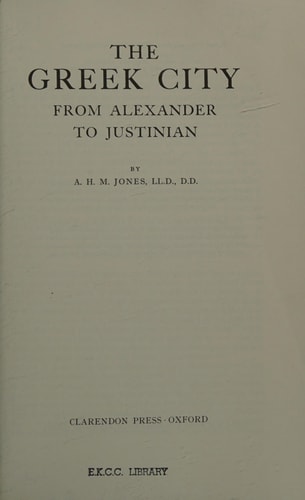
The Greek City from Alexander to Justinian
0
0
As an Amazon Associate and affiliate partner, Menrva Books earns from qualifying purchases. Learn more
Author Description
Jones begins by describing the movement whereby Greek politcal institutions swept over the Near Eastern lands conquered by Alexander. He then goes on to trace the adaptation of the city to its new environment, the Hellenistic kingdom and the Roman empire. The city's internal political life, how it was transformed from an autonomous community to a seat of local government, and the manifold services it provided its citizens are also described. Finally, an attempt is made to assess the contribution of the city to the civilization of the regions where it prevailed.
Menrva's Summary
THE THESIS
This work investigates the evolution and functional transformation of the Greek city-state as it navigated the shifting geopolitical landscapes from the conquests of Alexander the Great through the reign of Justinian. Arnold H. Jones, a distinguished historian of the ancient world, utilizes a comprehensive analysis of administrative records, legal frameworks, and socio-political developments to argue that the city served as the primary vehicle for Hellenistic and Roman cultural integration. By examining the transition from autonomous poleis to administrative units within larger imperial structures, the author provides a rigorous framework for understanding how local governance adapted to external hegemony.
THE SCOPE MAP
What You Will Find
- Analysis of the expansion of Greek political institutions across Near Eastern territories.
- Examination of the structural adaptation of urban centers under Hellenistic kingdoms and the Roman Empire.
- Detailed assessment of the internal political life and civic services provided by the city to its inhabitants.
- Evaluation of the long-term cultural and civilizational contributions of the Greek city to the Mediterranean and Near Eastern regions.
THE AUTHORITY PERSPECTIVE
Scholars and historians frequently cite this text as a foundational resource for understanding the administrative history of the ancient Mediterranean. Readers often note the academic density of the prose, which provides a thorough and authoritative account of urban development across several centuries.
Page Count:
404
Publication Date:
1980-01-17
Publisher:
Oxford University Press
ISBN-10:
0198148429
ISBN-13:
9780198148425
History
Cities And Towns
Urban History
Ancient History
Community Tags
Similar Books