Quintus Cicero: A Brief Handbook on Canvassing for Office (Commentariolum Petitionis)
0
0
As an Amazon Associate and affiliate partner, Menrva Books earns from qualifying purchases. Learn more
Author Description
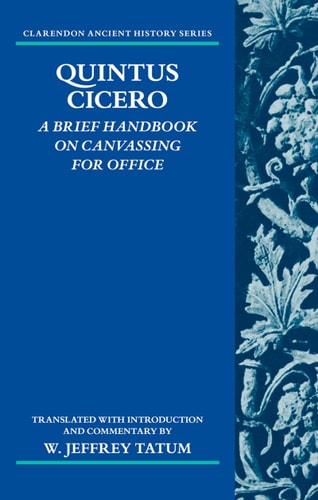
Rome's annual elections were central to the relationship between its citizenry and political leadership, and canvassing for office played no small part in their outcomes. The Brief Handbook on Canvassing for Office (Commentariolum Petitionis), composed by Quintus Cicero for his elder brother, the famous orator and statesman Marcus, is our fullest account of campaigning for office in republican Rome, incorporating candid advice on how best to mobilize political support from voters of every social class alongside searing political vituperation.This volume offers both the Latin text and a fresh translation of the Brief Handbook, as well as the first scholarly commentary on the text in the English language. Its purpose is to aid readers in their appreciation of the Brief Handbook in its multiple guises: as a literary text, an ideological document, a likely specimen of electoral propaganda, and a resource for recovering various aspects of late republican political and cultural history, such as group identities, Roman friendship, and civic rituals. While the comprehensive commentary clarifies the cultural, historical, and literary problems of the text, an incisive introduction supplies the reader with an account of the nature and practice of elections and canvassing for office in the late republic, as well as a detailed rehearsal of particular aspects of Cicero's career that provides the necessary context for understanding his campaign for the consulship in 64. The introduction also examines the literary dimensions of the work, and particularly the question of its authorship: considerations that are crucial to its proper interpretation as a historical source.
Menrva's Summary
THE THESIS
This volume investigates the mechanics of Roman electoral politics by analyzing the Commentariolum Petitionis, a foundational document on campaign strategy. W. Jeffrey Tatum, a scholar of Roman history, provides a critical examination of this text, which was written by Quintus Cicero to advise his brother Marcus during his 64 BCE campaign for the consulship. The book argues that the handbook serves as both a practical guide to political mobilization and a significant historical artifact reflecting the social and cultural tensions of the late Roman Republic. By integrating the original Latin text with a modern translation and extensive commentary, the author provides a framework for understanding the complexities of republican political life.
THE SCOPE MAP
What You Will Find
- A detailed analysis of electoral practices and canvassing strategies in the late Roman Republic.
- A comprehensive scholarly commentary on the Commentariolum Petitionis, addressing historical and literary nuances.
- An examination of the authorship debate surrounding the document and its implications for historical interpretation.
- Contextual insights into Roman social classes, civic rituals, and the nature of political friendship.
THE AUTHORITY PERSPECTIVE
Scholars and students of classical history recognize this volume as a definitive resource for analyzing the political culture of the late Roman Republic. Readers frequently note the academic density of the prose, which provides a rigorous and necessary foundation for understanding the complexities of ancient Roman governance.
Page Count:
368
Publication Date:
2018-11-27
Publisher:
Oxford University Press
ISBN-10:
0198153074
ISBN-13:
9780198153078
Biography
History
Ancient History
Roman History
Community Tags
Similar Books