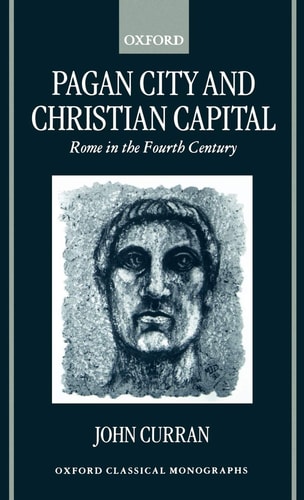
Pagan City and Christian Capital: Rome in the Fourth Century
0
0
As an Amazon Associate and affiliate partner, Menrva Books earns from qualifying purchases. Learn more
Author Description
The critical century between the arrival of Constantine and the advance of Alaric in the early fifth century witnessed dramatic changes in the city of Rome. In this book Dr. Curran has broken away from the usual notions of religious conflict between Christians and pagans, to focus on a number of approaches to the Christianization of Rome. He surveys the laws and political considerations which governed the building policy of Constantine and his successors, the effect of papal building and commemorative constructions on Roman topography, the continuing ambivalence of the Roman festal calendar, and the conflict between Christians over asceticism and "real" Christianity. Thus using analytical, literary, and legal evidence Dr Curran explains the way in which the landscape, civic life, and moral values of Rome were transformed by complex and sometimes paradoxical forces, laying the foundation for the capital of medieval Christendom. Through a study of Rome as a city Dr Curran explores the rise of Christianity and the decline of paganism in the later Roman empire.
Menrva's Summary
THE THESIS
This book investigates the complex transformation of Rome from a pagan center to a Christian capital during the fourth century. Dr. John R. Curran, a scholar of classical history, challenges traditional narratives of binary religious conflict by examining the nuanced interplay between political policy, urban development, and social practice. By synthesizing legal records, literary sources, and archaeological evidence, the author constructs a framework that explains how the city's physical and moral landscape evolved under the influence of Constantine and his successors.
THE SCOPE MAP
What You Will Find
- Analysis of fourth-century Roman urban topography and commemorative construction.
- Examination of the political and legal frameworks governing imperial building policies.
- Study of the Roman festal calendar and its evolution amidst shifting religious demographics.
- Investigation into internal Christian debates regarding asceticism and moral identity.
THE AUTHORITY PERSPECTIVE
Scholars and students of late antiquity frequently cite this work for its departure from simplistic models of religious transition in favor of a more integrated historical analysis. Readers often note the academic density of the prose, which serves as a foundational text for understanding the structural shifts in the Roman capital during the transition to the medieval era.
Page Count:
416
Publication Date:
2000-11-30
Publisher:
Clarendon Press
ISBN-10:
0198152787
ISBN-13:
9780198152781
History
Religion
Ancient History
Roman Empire
Community Tags
Similar Books