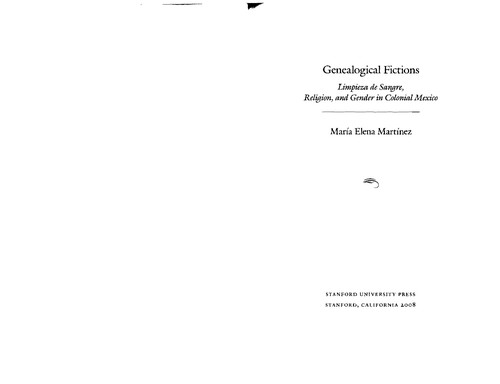
Genealogical Fictions
0
0
As an Amazon Associate and affiliate partner, Menrva Books earns from qualifying purchases. Learn more
Author Description
Maria Elena Martinez's Genealogical Fictions is the first in-depth study of the relationship between the Spanish concept of limpieza de sangre (purity of blood) and colonial Mexico's sistema de castas, a hierarchical system of social classification based primarily on ancestry. Specifically, it explains how this notion surfaced amid socio-religious tensions in early modern Spain, and was initially used against Jewish and Muslim converts to Christianity. It was then transplanted to the Americas, adapted to colonial conditions, and employed to create and reproduce identity categories according to descent. Martinez also examines how the state, church, Inquisition, and other institutions in colonial Mexico used the notion of purity of blood over time, arguing that the concept's enduring religious, genealogical, and gendered meanings and the archival practices it promoted came to shape the region's patriotic and racial ideologies.--BOOK JACKET.
Menrva's Summary
THE THESIS
This book investigates the historical development and application of the Spanish concept of 'limpieza de sangre' (purity of blood) and its influence on the colonial Mexican 'sistema de castas'. It explains how this notion, initially used against converts in early modern Spain, was transplanted to the Americas and adapted to create and reproduce identity categories based on descent. The author examines how various institutions in colonial Mexico utilized the concept of purity of blood over time, arguing that its enduring religious, genealogical, and gendered meanings shaped the region's patriotic and racial ideologies.
THE SCOPE MAP
- What You Will Find:
- The historical emergence of 'limpieza de sangre' in early modern Spain and its application against religious converts.
- The transplantation and adaptation of this concept to the colonial Mexican 'sistema de castas'.
- An examination of how institutions like the state, church, and Inquisition used purity of blood to classify society.
- Analysis of the enduring religious, genealogical, and gendered meanings of purity of blood.
- The role of purity of blood in shaping patriotic and racial ideologies in colonial Mexico.
- Discussion of the archival practices promoted by the concept of purity of blood.
THE AUTHORITY PERSPECTIVE
The book is recognized as the first in-depth study to connect the Spanish concept of 'limpieza de sangre' with colonial Mexico's 'sistema de castas'. It is noted for explaining how this notion was initially used against converts in Spain before being adapted in the Americas to classify individuals based on descent. The work further details how various institutions in colonial Mexico employed this concept, ultimately arguing for its significant role in shaping regional ideologies.
Page Count:
407
Publication Date:
2008-01-01
ISBN-10:
0804756481
ISBN-13:
9780804756488
History
Non-Fiction
Social History
Genealogy
Identity
Race
Colonialism
Community Tags
Similar Books