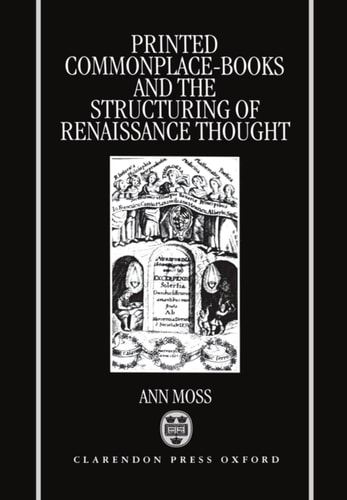
Printed Commonplace-Books and the Structuring of Renaissance Thought
0
0
As an Amazon Associate and affiliate partner, Menrva Books earns from qualifying purchases. Learn more
Author Description
Commonplace-books were the information-organizers of Early Modern Europe, notebooks of quotations methodically arranged for easy retrieval. From their first introduction to the rudiments of Latin to the specialized studies of their later years, the pupils of humanist schools were trained to use commonplace-books. The common-place book mapped and resourced Renaissance culture's moral thinking, its accepted strategies of argumentation, its rhetoric, and its deployment of knowledge. In this study, Ann Moss investigates the evolution of the commonplace-book from its medieval antecedents, through its humanist realization, its later printed manifestations, and, finally, to its gradual decline in the seventeenth century.
Menrva's Summary
THE THESIS
This study investigates how the practice of maintaining commonplace-books functioned as a primary mechanism for organizing and structuring intellectual thought during the Renaissance. Ann Moss examines the pedagogical foundations of humanist education, tracing the evolution of these information-organizing notebooks from their medieval origins to their eventual decline in the seventeenth century. By analyzing the transition from manuscript to print, the author demonstrates how these tools shaped the rhetorical strategies and moral frameworks of Early Modern European culture.
THE SCOPE MAP
What You Will Find
- Historical evolution of commonplace-books from medieval antecedents to seventeenth-century decline.
- Analysis of humanist pedagogical methods and the training of students in information retrieval.
- Examination of the role of printed commonplace-books in the deployment of Renaissance knowledge.
- Exploration of the intersection between rhetoric, argumentation, and moral philosophy in Early Modern intellectual life.
THE AUTHORITY PERSPECTIVE
Scholars and historians frequently cite this work as a foundational text for understanding the intellectual infrastructure of the Renaissance period. Readers often note the academic density of the prose, which provides a rigorous examination of how early modern thinkers managed and categorized information.
Page Count:
360
Publication Date:
1996-05-23
Publisher:
Clarendon Press
ISBN-10:
0198159080
ISBN-13:
9780198159087
History
Renaissance
Intellectual History
Literary Criticism
Books