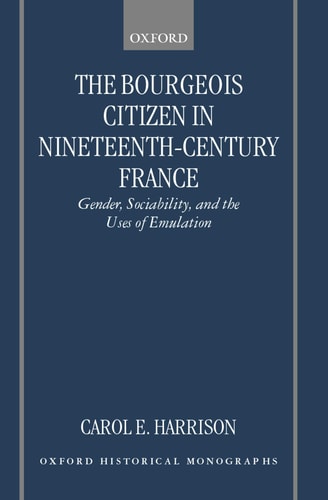
The Bourgeois Citizen in Nineteenth Century France: Gender, Sociability, and the Uses of Emulation
0
0
As an Amazon Associate and affiliate partner, Menrva Books earns from qualifying purchases. Learn more
Author Description
This book analyzes the process by which class society developed in post-revolutionary France. Carol E. Harrison addresses the construction of class and gender identities, and shows how the sociable interaction of male citizens was the crucial bridge between the destruction of France's old regime and the development of a mature industrial class society.
Menrva's Summary
THE THESIS
How did the formation of class and gender identities in post-revolutionary France facilitate the transition from the old regime to a modern industrial society? Carol E. Harrison, a historian specializing in nineteenth-century France, utilizes archival research and social theory to examine the role of voluntary associations and public sociability. She argues that the interactions of male citizens within these spaces served as a critical mechanism for defining bourgeois identity and establishing social order during a period of significant political instability.
THE SCOPE MAP
What You Will Find
- Analysis of post-revolutionary French social structures and the evolution of the bourgeoisie.
- Examination of voluntary associations as sites of political and social identity formation.
- Investigation into the intersection of gender roles and class-based sociability.
- Discussion of the concept of emulation as a tool for social cohesion and class development.
THE AUTHORITY PERSPECTIVE
Historians and scholars of nineteenth-century Europe frequently cite this work as a significant contribution to the study of social identity and civil society. Experts highlight the author's rigorous use of primary sources to map the complex relationship between private association and public political life.
Page Count:
280
Publication Date:
1999-09-16
Publisher:
Clarendon Press
ISBN-10:
0198207778
ISBN-13:
9780198207771
History
Politics
French History
Gender Studies
Europe
European History
Social History
Sociology
Community Tags
Similar Books